Best Large Yogurt Maker for Two People: Euro Cuisine Leads

Five 2-quart yogurt makers compared on jar size, timer range, temperature control and warranty. The Euro Cuisine YM260 leads on run time; the Bear wins for Greek.

By Jo LoweryUpdated 14 min read
On this page
- Best large yogurt maker for two people at a glance
- How I narrowed the field to five
- Why 2 quarts is the sweet spot for two
- 1. Euro Cuisine YM260 — Best overall
- 2. Bear SNJ-C10T1 — Best upgrade
- 3. HOPERAN BZ-2177 — Most versatile
- 4. Suteck BZ-2387 — Best minimal setup
- 5. JoyMech JM-2-YM01 — Best budget pick
- One jar or two: which layout wins?
- How long a batch really takes
- What the listings do not tell you
- The verdict
- FAQ
The best large yogurt maker for two people is the Euro Cuisine YM260, a 2-quart glass-jar unit with an adjustable 78°F–132°F range and up to 99 hours of run time, backed by a 3-year warranty. If you eat more Greek yogurt than plain, the Bear SNJ-C10T1 is the better buy because it ships with a 100-mesh strainer and two 33.8 oz stainless bowls. Both hold enough for a week of breakfasts without leaving whey to go sour in the fridge.
Best large yogurt maker for two people at a glance
| Pick | Capacity | Timer / temperature | Price |
|---|---|---|---|
Best overall Euro Cuisine YM260 |
2-quart glass jar | Up to 99 h 78–132°F |
Check Price |
Best upgrade Bear SNJ-C10T1 |
2 x 33.8 oz stainless | Up to 14 h preset per mode |
Check Price |
Most versatile HOPERAN BZ-2177 |
2 x 1-quart bowls | Up to 48 h 68–131°F |
Check Price |
Best minimal setup Suteck BZ-2387 |
2 glass jars, 2 qt total | 0–48 h 68–131°F |
Check Price |
Best budget pick JoyMech JM-2-YM01 |
2 x 1-quart glass | 8–12 h (one-touch) preset |
Check Price |



How I narrowed the field to five
The category is crowded with tiny four-jar sets built for kids' lunchboxes. Those are the wrong shape for the household this article is written for. I filtered on published capacity first, keeping only machines that hold at least 2 quarts across their jars or bowls, because two adults eating yogurt daily go through roughly a quart between them every three days.
From there I looked at three things:
- Timer range in hours, because L. Reuteri and some heirloom cultures need 24 to 36 hours.
- Temperature control, adjustable or fixed.
- Whether the jars are glass, stainless or plastic.
A note on the qualifier. Amazon's search treated "for two people" as a soft hint rather than a hard filter, so no listing here is certified as a two-person appliance. That is a judgment call for the reader. What I can say is that every pick holds 2 quarts, which is the batch size a two-person household actually uses before yogurt starts to sour.
The five that survived cover four price positions and every jar material in the category. Nothing in the shortlist is a re-badge of another entry.
Why 2 quarts is the sweet spot for two
Homemade yogurt keeps for about 10 to 14 days in the fridge before the acidity climbs past pleasant. Two adults eating a 6 oz serving at breakfast get through 12 oz a day, or roughly 84 oz a week. That is 2.6 quarts. A 2-quart machine covers about six days, which lines up neatly with a weekly ferment.
Go smaller and you make yogurt twice a week. Go larger and the last jar tastes sharp by the time you open it. That is why every pick in this roundup lands at or near 2 quarts, and why the Euro Cuisine's single 2-quart jar and the Bear's two 33.8 oz bowls are near-identical in usable output.
The layout matters more than the raw number:
- One big jar is easier to clean and easier to strain for Greek yogurt.
- Two smaller bowls let you run two flavours or two cultures at once.
- Multiple small jars in the four-to-eight-jar sets are for portion control, which two adults rarely need at home.
1. Euro Cuisine YM260 — Best overall
The YM260 wins on run-time headroom, on warranty and on the single-jar layout that matches how two adults actually eat yogurt.
Best for: a two-person household eating yogurt daily and wanting long, slow ferments Skip it if: you want portioned single-serve jars instead of one big batch
The YM260 is one of two picks with published temperature control at both ends (78°F to 132°F) and the only one with a stated timer that runs up to 99 hours. That matters because the trendy probiotic strains, L. Reuteri especially, need 24 to 36 hours at low temperature to culture properly. A 14-hour timer cannot do that. A 48-hour timer just about can. 99 hours removes the ceiling entirely.
The single 2-quart glass jar is easier to strain and easier to clean than a two-bowl setup, and Euro Cuisine throws in a thermometer and a cotton strainer bag. Weight is 4 lb and the footprint is 10.5 x 7.5 x 7.5 in, so it takes up about the same counter space as a small drip coffee maker. The 3-year warranty is the longest published in this set. The catch: it is the most expensive pick here, and the single jar means you cannot run plain and Greek batches side by side.
Pros:
- 99-hour timer covers L. Reuteri and heirloom cultures
- Adjustable 78–132°F range in a category that often runs fixed
- 3-year warranty, the longest published here
- 2-quart glass jar included, plus thermometer and strainer bag
- BPA-free glass rather than plastic
Cons:
- The most expensive pick in this set
- Single jar means no side-by-side batches
- Only two sellers list it, so stock can be thin
2. Bear SNJ-C10T1 — Best upgrade
The Bear is the pick built around Greek yogurt: two 33.8 oz stainless bowls, a 100-mesh strainer in the box and multi-mode presets for kefir, cheese and fruit wine.
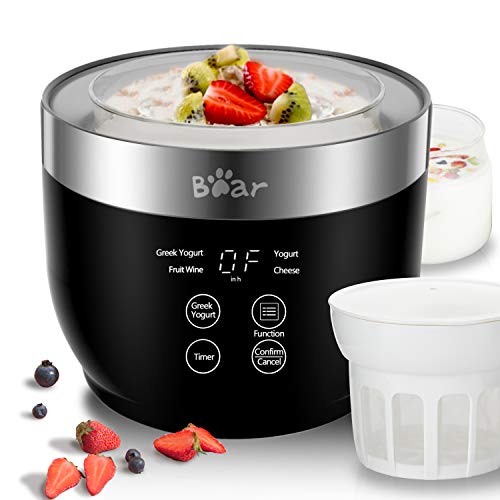
Best for: anyone who eats Greek yogurt more than plain and wants a strainer in the box Skip it if: you plan ferments longer than 14 hours
Greek yogurt is what changes the shopping decision here. To make it you ferment normal yogurt, then strain the whey through fine mesh until the texture thickens. Most yogurt makers assume you own the strainer. The Bear ships one, a 100-mesh cup that sits inside the pot, and Bear says the stainless steel inner pot heats more evenly than the plastic-sleeved units elsewhere in this set.
The trade-off is the timer. Bear says the microcomputer holds a constant temperature per function and lets you dial time up to 14 hours. That is fine for a standard ferment and generous for Greek, but it rules out the very-long L. Reuteri protocols the Euro Cuisine can run. The 3.5 lb body is the lightest of the picks with a published weight, and the two 33.8 oz bowls make roughly the same total volume as the Euro Cuisine's single jar. If Greek yogurt is your default, the strainer alone saves you buying a separate one.
Pros:
- 100-mesh strainer included for Greek yogurt
- 304 stainless inner pot, per Bear's listing
- Multi-mode: yogurt, Greek, cheese, kefir, fruit wine
- Two 33.8 oz bowls for parallel batches
- Lightest published weight in the set at 3.5 lb
Cons:
- 14-hour timer ceiling rules out L. Reuteri runs
- No published warranty
- Sits in the premium price position without a temperature range in the listing
3. HOPERAN BZ-2177 — Most versatile
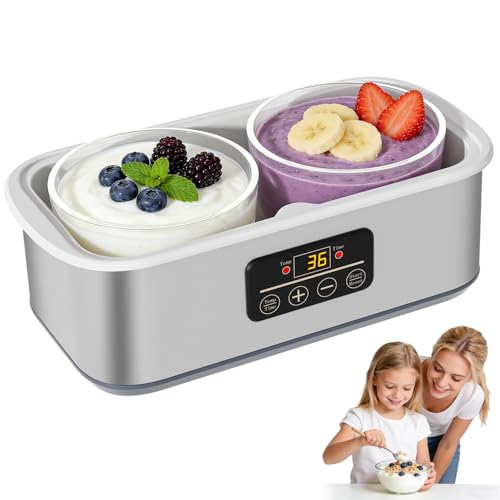
The HOPERAN pairs two 1-quart bowls with a 68–131°F adjustable range and a 48-hour timer, at the second-cheapest price in the set.
Best for: two people who want portioned bowls and long ferments without a premium price Skip it if: you want a published warranty on the machine
Two 1-quart bowls give you flexibility the Euro Cuisine cannot. Run plain in one, Greek in the other. Try a new culture in bowl B while bowl A holds the strain you trust. The 68–131°F range is the widest low-end of any pick here, useful because L. Bulgaricus prefers the low 100s while thermophilic strains want it hotter. HOPERAN says the machine runs up to 48 hours, which is enough for almost every ferment except the extreme probiotic protocols.
The footprint tells you the layout: 5.1 x 14.1 x 7.3 in, wider than it is deep because the two bowls sit side by side. Weight is not listed, and neither is warranty length, which is the main gap against the Euro Cuisine. Only one seller stocks it. The four-step operation (pour, place, fill water, set time) is standard for this category and no harder than the pricier picks. For a household that wants twin bowls and adjustable temperature without paying premium, this is where the numbers line up.
Pros:
- Two 1-quart bowls for parallel batches
- Wide 68–131°F adjustable range
- 48-hour timer covers most ferments
- BPA-free bowls per the listing
- Second-cheapest of the five picks
Cons:
- No published weight or warranty
- Only one seller listed
- Wider footprint than the single-jar units
4. Suteck BZ-2387 — Best minimal setup
The Suteck strips the category down to two glass jars, a 0–48-hour timer and 1°F temperature steps in a stainless housing.

Best for: buyers who want two glass jars and simple 1-degree temperature steps Skip it if: you need a ferment window past 48 hours
Suteck's pitch is precision without frills. The listing describes 1°F increments across the 68–131°F range, with ±1°C accuracy. That is finer than most of the field claims. The 25W energy figure Suteck states is the only power draw published in this set, and it puts the machine on par with a small light bulb during a long ferment.
Two BPA-free glass jars make up the 2-quart total, so you can run two flavours the way the HOPERAN allows, but in glass rather than plastic. The stainless housing pushes the price to mid-range in this set. What is missing: a published weight, warranty, and a full model-year date. The listing gives you the numbers that matter for making yogurt and leaves off the ones you would look up later. For a buyer who wants the ferment parameters right and does not mind the missing paperwork, that is a reasonable trade. For anyone chasing L. Reuteri, the 48-hour ceiling is close but not roomy.
Pros:
- 1°F temperature steps across 68–131°F
- Two BPA-free glass jars for parallel batches
- 25W energy draw published
- Stainless steel housing
- Handles yogurt, Greek, labneh and paneer per listing
Cons:
- 48-hour timer ceiling
- No published weight or warranty
- Slowest seller of the five here
5. JoyMech JM-2-YM01 — Best budget pick
The JoyMech is the cheapest of the five, with two 1-quart glass jars and one-touch operation for buyers testing the yogurt habit.

Best for: first-time yogurt makers testing the habit before committing Skip it if: you want adjustable temperature control
JoyMech keeps the interface to one button. Pour milk and starter into the jars, press start, and the machine ferments for 8 to 12 hours at a preset temperature. That is the whole operating manual. For someone who is not sure they will still be making yogurt in six months, the simplicity is a feature, not a limitation.
Two 1-quart glass jars match the layout of the HOPERAN and Suteck, and the listing calls the lid transparent and the jars dishwasher-safe. What you give up at this price is adjustable temperature and any timer flexibility past the preset window. That rules out slow ferments, Greek yogurt at your own thickness point, and non-standard cultures. Plain 8-hour yogurt in whole milk works exactly as the listing describes. Anything else is either impossible or a guess. If yogurt sticks as a habit, you upgrade in a year to one of the picks above. If it does not, you have not lost much.
Pros:
- Cheapest of the five picks
- Two 1-quart glass jars with transparent lid
- Dishwasher-safe jars per listing
- One-touch operation for beginners
- 8–12 hour ferment window covers standard recipes
Cons:
- No adjustable temperature
- Fixed timer rules out Greek and long ferments
- No published warranty or weight
One jar or two: which layout wins?
The single-jar Euro Cuisine and the twin-jar HOPERAN, Suteck and JoyMech solve the two-person problem in opposite ways. Both hold 2 quarts. Both fit on a counter. What separates them is how yogurt gets used mid-week.
Reasons to pick a single 2-quart jar:
- Cleaning is one jar and one lid, not two.
- Straining for Greek yogurt is easier with one large volume.
- The batch stays homogeneous, so the last serving tastes like the first.
Reasons to pick two 1-quart jars:
- You can run plain and Greek in the same session.
- One jar goes to the fridge on day one; the second starts a fresh ferment on day four.
- If a batch fails, you have lost half your milk, not all of it.
The Bear splits the difference with two stainless bowls plus the Greek strainer, which is why it earns the upgrade slot rather than sitting in either camp. For most two-person households the honest answer is the one you will actually reach for, which usually means matching how you eat: one flavour, one jar; two flavours, two jars.
How long a batch really takes
Plain yogurt is a mostly-hands-off appliance job, but the total elapsed time from cold milk to fridge-ready yogurt is longer than the timer suggests.
A typical session runs like this:
- Heat the milk to about 180°F on the stovetop, then cool to roughly 110°F. Around 30 to 45 minutes, active.
- Stir in starter culture and pour into the jars. Two minutes.
- Ferment at the machine's set temperature. This is where the picks diverge: 8 to 12 hours on the JoyMech, up to 14 on the Bear, 48 on the HOPERAN and Suteck, and 99 on the Euro Cuisine.
- Chill in the fridge for 4 hours minimum before eating.
- Strain for Greek, another 2 to 8 hours depending on thickness.
Total wall-clock time for standard plain yogurt is roughly 14 hours from start to breakfast. For Greek, closer to 22. That is why the timer ceiling matters more than the average buyer expects: a machine that stops at 14 hours cannot do a leisurely overnight run followed by a workday of straining without you being home to intervene.
What the listings do not tell you
A few gaps show up across the whole set that a first-time buyer should know about.
- Warranty is rare. Only the Euro Cuisine YM260 publishes one (3 years). Every other pick leaves the field blank, which does not mean no warranty, but it does mean you would have to check with the seller before you commit.
- Weight is inconsistent. Two picks (Euro Cuisine and Bear) publish a weight; three do not. If you plan to store the machine on a high shelf between uses, that is a call-the-seller question.
- Starter cultures are separate. No pick ships with a starter. You need either a spoonful of live yogurt or a sachet of freeze-dried culture from a grocery or supplement shop.
- Milk choice changes the result. Whole milk makes thicker yogurt than skim. Ultra-pasteurised milk sometimes refuses to set. The machines cannot fix a milk-choice mistake.
- Cleaning is manual for the housing. The jars on the JoyMech are dishwasher-safe per the listing; the housings on every pick are wipe-down only.
None of these are dealbreakers. They are the small friction points nobody mentions when they hand you a jar of homemade yogurt and say how easy it is.
The verdict
The Euro Cuisine YM260 is the right default for a two-person household. It ferments the volume you actually eat in a week, it runs long enough for any culture on the market, and it is the only pick in this set with a published 3-year warranty. The single 2-quart glass jar is easier to clean and easier to strain than the twin-bowl layouts.
Two conditions flip that verdict. First, if you eat more Greek yogurt than plain, buy the Bear SNJ-C10T1 instead: the 100-mesh strainer and two stainless bowls turn a two-step process into one appliance, and the multi-mode presets cover kefir and soft cheese too. Second, if you want twin bowls to run parallel batches without paying premium, the HOPERAN BZ-2177 matches the Euro Cuisine on temperature range at half the price position, though it gives up the warranty.
The JoyMech is a sensible trial run for a first-time yogurt maker who is not sure the habit will stick. The Suteck appeals to a narrow buyer who cares about 1°F temperature steps. Neither is where a two-person household eating yogurt every morning should land as a first purchase.
FAQ
Is a 2-quart yogurt maker enough for two people?
A 2-quart yogurt maker is enough for two people eating a standard 6 oz serving each day. That works out to roughly 84 oz a week, and a full 2-quart batch covers about six days before the acidity starts climbing. Every pick in this roundup holds 2 quarts across one jar or two bowls, which is why the layout matters more than raw capacity.
Is it worth buying a yogurt maker for just two people?
Buying a yogurt maker for just two people pays off quickly if you eat yogurt daily. A weekly 2-quart batch replaces four or five store tubs, and you control the milk, the sweetness and the strain. If yogurt is a once-a-fortnight snack, an oven with the light on will do the job. The Euro Cuisine YM260 and the JoyMech bracket the range of realistic buy-in.
What temperature range should I look for in the best large yogurt maker for two people?
The temperature range matters because different cultures want different heat. Standard yogurt sets between 108°F and 115°F. Kefir wants cooler, around 78°F. L. Reuteri needs low 90s for 24 hours or more. An adjustable range from roughly 68°F to 130°F, like the HOPERAN and Suteck offer, covers everything a home fermenter reasonably tries. Fixed-temperature machines like the JoyMech handle plain yogurt only.
Euro Cuisine YM260 or Bear SNJ-C10T1: which should I buy?
Euro Cuisine YM260 or Bear SNJ-C10T1 comes down to what yogurt you eat. Choose the YM260 for plain, drinkable and long-fermented probiotic yogurts, thanks to its 99-hour timer and 3-year warranty. Choose the Bear if Greek is your default and you want the 100-mesh strainer and stainless bowls in the box. The YM260 runs longer; the Bear finishes thicker.
What is the biggest mistake first-time yogurt maker buyers make?
The biggest mistake first-time yogurt maker buyers make is picking on jar count instead of timer flexibility. A pretty six-jar set looks like the answer for a two-person household, but the fixed short timer rules out Greek, kefir and the probiotic strains people actually buy the machine for. Look at the timer ceiling and the temperature range before you look at how many jars are in the picture.
Start with the milk you already buy and one sachet of freeze-dried culture. Set the machine on a Sunday evening, wake up to warm yogurt, and chill it through Monday for breakfast on Tuesday. Two people will finish a 2-quart batch by Friday or Saturday, and the empty jar goes back in the machine the same night. The Euro Cuisine YM260 earns its top slot because that weekly rhythm is exactly what its long timer, wide temperature range and single 2-quart jar are shaped around. Nothing else in the set matches all three at once.