Best Quiet Roti Maker for Beginners: Victoria Wins

A beginner-first ranking of six roti makers, from an 8 lb cast iron press to a 46 lb touchscreen machine, with the trade-offs that decide which one belongs on your counter.

By Jo LoweryUpdated 15 min read
On this page
- How I screened the shortlist
- Best quiet roti maker for beginners at a glance
- Why the deciding spec is not wattage
- 1. Victoria 8 Inches Cast Iron Tortilla Press — Best overall
- 2. Orixforce 12-Inch Stainless Steel Nonstick Electric — Runner-up
- 3. Saachi SA1650 Electric Non-Stick Roti Chapati Flat Bread — Best for pros
- 4. ZHIBIMOI Fully Automatic Roti Maker — Best minimal setup
- 5. ToolHaven Fully Automatic Roti Maker with Touchscreen — Best upgrade
- 6. Apecoo Roti Maker, Electric Chapati and Tortilla Machine — Best premium
- How quiet is a roti maker, really?
- What the listings do not tell beginners
- Manual press or electric machine?
- The verdict
- FAQ
The best quiet roti maker for beginners is the Victoria 8 Inches Cast Iron Tortilla Press, an 8 lb manual press with a limited lifetime warranty and no motor to hum, whine or fail. If you want an electric plate with adjustable heat instead, the Orixforce 12-inch 1200W press is the runner-up, and the deciding specification is not wattage.
How I screened the shortlist
I started with every roti and tortilla maker listed under Amazon's Quesadilla & Tortilla Makers and Bread Machines categories, then cut the field on three rules.
- Published dimensions and weight. A beginner needs to know if the thing fits on a counter and can be lifted onto a shelf. Listings without both were cut.
- A stated cooking method. Manual press, heated plate, or fully automatic. A vague "multi-function" listing was cut.
- A single seller and a clean product page. Every pick here has an
offer_countof one, which means one party is responsible for the listing.
That left six: two manual or press-only units, one thermostat plate, and three fully automatic machines. The set spans an 8 lb cast iron press up to a 46.3 lb touchscreen unit, and the entry price band up to the premium tier. This is the field a beginner is choosing from when they search for the best quiet roti maker for beginners, and the honest answer is that "quiet" and "beginner" pull in opposite directions once a motor is involved.
Best quiet roti maker for beginners at a glance
| Pick | Type | Weight | Price |
|---|---|---|---|
Best overall Victoria 8" Cast Iron Press |
Manual cast iron press | 8 lb | Check Price |
Runner-up Orixforce 12" Electric Press |
Electric press, 1200W | 8 lb | Check Price |
Best for pros Saachi SA1650 Electric Roti Maker |
Electric press, thermostat | 6 lb | Check Price |
Best minimal setup ZHIBIMOI Automatic Roti Maker |
Fully automatic, touchscreen | 44.1 lb | Check Price |
Best upgrade ToolHaven Automatic Roti Maker |
Fully automatic, touchscreen | 46.3 lb | Check Price |
Best premium Apecoo Automatic Roti Maker |
Fully automatic, brushless motor claim | not listed | Check Price |



Why the deciding spec is not wattage
Most flatbread appliance guides open with wattage. That is not what decides the best quiet roti maker for beginners.
A cast iron press has no wattage at all, no motor, no fan, and no cooling cycle. It is silent by construction. An electric press adds a heating element but not moving parts, so the only sound is the click of a thermostat. A fully automatic machine adds a motor, a hopper, a dispenser and often a fan, and that is where noise gets designed in or out.
Wattage tells you how fast the plate reaches temperature. It does not tell you how loud the machine will be at 6am, how forgiving the interface is, or whether you can lift the unit into a cabinet after dinner. For a beginner, the deciding specification is the noise floor of the mechanism and the weight of the appliance, in that order. Every recommendation below is anchored to those two figures, not to watts.
1. Victoria 8 Inches Cast Iron Tortilla Press — Best overall
A silent 8 lb cast iron press with a limited lifetime warranty is the honest answer to what a beginner actually needs.
Best for: beginners who want the quietest, simplest path to homemade roti Skip it if: you cannot lift or store an 8 lb cast iron press
This press is the only pick in the set with a limited lifetime warranty, and it is the cheapest of the six. It measures 3.1 x 8 x 8 in and weighs 8 lb, which is heavy for its size but the weight is the point: mass is what flattens dough evenly without you leaning on a handle. Victoria says the press is seasoned with non-GMO flaxseed oil and made without PTFE or PFAS coatings, which matters if you want to avoid non-stick chemistry on a heated surface.
The trade-off against every electric pick here is that you still cook the roti in a separate pan. The Victoria flattens, it does not bake. In practice that means a two-tool workflow: press, then dry skillet or tawa. For beginners that is a feature, not a bug, because a cast iron pan is easier to control than an unfamiliar electric plate. Of the six, this is the one buyers choose most often, by a wide margin over the automatics.
Pros:
- Silent by design, no motor or fan
- Limited lifetime warranty, unique in this set
- Compact 3.1 x 8 x 8 in footprint
- Cheapest of the six
- No synthetic non-stick coating
Cons:
- Requires a separate pan or tawa to cook
- 8 lb is heavy for a small press
- Not dishwasher safe, hand-care only
- Learning curve on dough thickness
2. Orixforce 12-Inch Stainless Steel Nonstick Electric — Runner-up
A 1200W electric press with adjustable heat and a 12-inch plate for cooks who want one machine that both flattens and cooks.
Best for: cooks who want an electric press with adjustable heat Skip it if: you need published dimensions before you buy
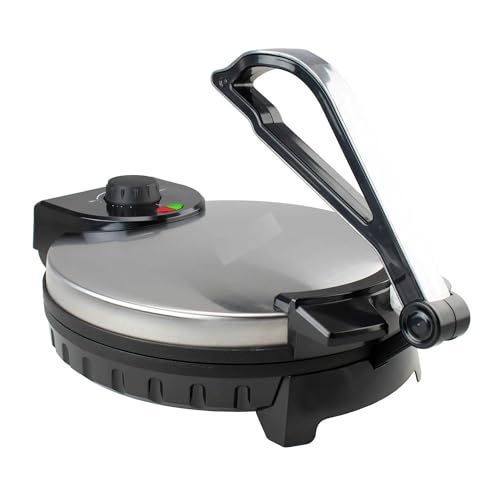
The Orixforce combines press and cook in one appliance. It runs at 1200W across a 12-inch nonstick aluminium plate, and Orixforce says the adjustable heat lets you dial softness or crispness. The unit weighs 8 lb, the same as the Victoria, but here that weight includes the heating element and the hinged top plate, so a beginner is not fighting a heavy manual push. Power and preheat indicator lights handle the "is it ready" question that trips up first-time roti cooks on a bare skillet.
The problem is the listing itself: the dimensions field reads 0 x 0 x 0 in, which is a data gap the manufacturer has not filled. You are buying a 12-inch plate without a stated external footprint. That is a real risk if your counter space is tight, and it is the reason this sits at number two rather than number one. Against the automatics, though, the Orixforce is much lighter, much simpler and has no motor noise to design around.
Pros:
- 1200W across a 12-inch plate
- Adjustable heat for softer or crisper flatbreads
- Presses and cooks in one appliance
- Nonstick aluminium plates for easy release
- Only 8 lb, easy to move
Cons:
- External dimensions not published in the listing
- No stated warranty
- Nonstick aluminium wears with metal tools
- Cord-tethered, unlike the Victoria
3. Saachi SA1650 Electric Non-Stick Roti Chapati Flat Bread — Best for pros
A UL-approved 6 lb electric press with a thermostat, for someone who already knows their dough and wants precise plate temperature.

Best for: someone comfortable pressing dough and wants a thermostat-controlled plate Skip it if: you want puffed phulka, which the listing rules out
The Saachi is the lightest electric option here at 6 lb, in an 8 x 12 x 10 in chrome body that stores upright. Saachi is unusually honest in its own listing: it says the SA1650 makes "flat rotis and not the fluffed up phulkaas". That single line saves a buyer from returning the unit because it did not deliver the puff a home cook expected. The thermostat controls the plate temperature directly, which is why I have labelled this the pick for pros: it rewards someone who understands why a hotter plate scorches thin dough and a cooler plate produces leathery bread.
The award label is not a warning off beginners so much as a signal that this appliance gives you control and expects you to use it. If you are new to roti and want a machine to do the thinking, the Saachi will feel underspecified next to the automatics. If you already press dough and just want a hot, flat, thermostatted surface, it is the second-cheapest here and the smallest electric on the shortlist. Auto on/off and a ready light close the interface loop.
Pros:
- Lightest at 6 lb
- Thermostat controls plate temperature
- UL approved per the listing
- Auto on/off and ready indicator light
- Compact 8 x 12 x 10 in body
Cons:
- Listing states it does not produce puffed phulka
- No stated warranty
- No adjustable dough thickness
- Chrome finish shows fingerprints
4. ZHIBIMOI Fully Automatic Roti Maker — Best minimal setup
A fully automatic touchscreen machine at the smallest footprint of the three automatics, if the counter can carry 44 lb.

Best for: a household that wants a hands-off machine on a smaller footprint Skip it if: you have less than a square foot of clear counter
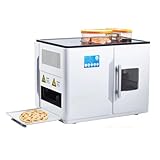
Of the three fully automatic machines here, the ZHIBIMOI has the smallest footprint at 15 x 15 x 13.8 in and the lightest body at 44.1 lb. That still means clearing a 15-inch square of permanent counter space, which is a bigger commitment than any of the presses. In exchange, ZHIBIMOI says the machine measures, dispenses, mixes and kneads on its own, producing 20 pieces at a time. The LCD touch panel adjusts thickness from 1.0 mm upward, plus roast and oil levels.
Two safety points from the listing are worth naming for a beginner: the machine stops automatically when the front door is open, and the surfaces the dough touches are described as detachable for cleaning. Neither of those is a substitute for the practical reality that a 44 lb appliance is not something you tuck away between meals. It lives on your counter, or it lives in a cabinet you can lift 44 lb into. That trade-off is the reason it sits at number four in a beginners' guide.
Pros:
- Smallest footprint of the three automatics
- Lightest automatic at 44.1 lb
- Adjustable thickness, roast and oil level
- Door-open safety stop per the listing
- 20-piece batch per cycle
Cons:
- Still 44 lb, not counter-friendly for small kitchens
- No published warranty
- Motor noise inherent to fully automatic design
- No stated wattage
5. ToolHaven Fully Automatic Roti Maker with Touchscreen — Best upgrade
The largest automatic here, for a household that wants a 20-piece batch and does not mind a 46 lb appliance.
Best for: a busy family that batches 20 flatbreads at a time Skip it if: your counter is under 22 inches deep
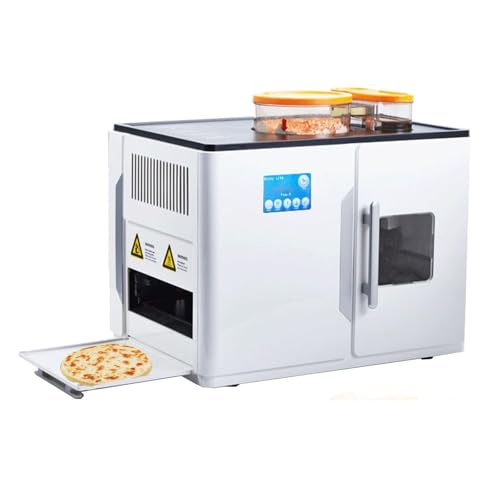
The ToolHaven is 18.1 x 21.3 x 16.1 in and 46.3 lb, and that 21.3 in depth is the number to check before you buy. Standard kitchen counters run 24 to 25 inches deep to the wall, so this leaves under three inches of clearance behind the unit. ToolHaven says the machine runs from dry flour to finished flatbread in about 120 seconds, with a thickness range starting at 1.0 mm and one-click 20-piece batches. The main body is stainless steel, and the front door pauses operation when opened.
Against the ZHIBIMOI, the ToolHaven is 2.2 lb heavier and noticeably deeper, but the interface and feature set are close. What tips this into "upgrade" territory rather than "minimal setup" is the larger cavity and the roomier working area behind the door. If you are cooking for six regularly, the extra size earns its counter space. If you are cooking for two, the ZHIBIMOI is the more honest fit. Sales rank is well behind the ZHIBIMOI in the same automatic category, which is worth knowing.
Pros:
- Full press-to-finish cycle in about 120 seconds per the listing
- 20-piece batch capacity
- Stainless steel body
- Adjustable thickness from 1.0 mm
- Door-open safety pause
Cons:
- 21.3 in depth crowds standard counters
- Heaviest of the three automatics at 46.3 lb
- Sells slower than the ZHIBIMOI
- No stated warranty
6. Apecoo Roti Maker, Electric Chapati and Tortilla Machine — Best premium
The only pick that publishes a low-noise claim, with dishwasher-safe removable parts, at the highest price position in this set.

Best for: a shopper who wants a dishwasher-safe automatic with a low-noise claim Skip it if: you want a strong sales history behind your purchase
Apecoo is the only listing in this set that names quiet operation directly. Apecoo says the machine uses a brushless motor and a "low noise mechanism", and adds that the detachable components are dishwasher safe with separated oil-water chambers and sealed pipelines. Three baking modes L1, L2 and L3 handle the roast level, and Apecoo claims a 90-second dry-flour-to-finished-roti cycle, faster than the ToolHaven's 120-second claim. The unit measures 16 x 15 x 16 in, which is between the ZHIBIMOI and the ToolHaven on footprint.
Two honest caveats. The listing does not publish a weight for this unit, which is unusual and worth checking before purchase given the other automatics land in the mid-40s. And it is the slowest seller of the six by a wide margin, and by far the most expensive pick here. If the low-noise claim and the dishwasher-safe parts are what you are buying, this is the pick. If you want an automatic with a track record, the ZHIBIMOI is the safer choice.
Pros:
- Low-noise mechanism per the listing
- Brushless motor claim
- Dishwasher-safe detachable parts per the listing
- 90-second cycle claim
- Three baking modes L1, L2, L3
Cons:
- Most expensive pick here
- Slowest-selling of the six
- Weight not published in the listing
- No stated warranty
How quiet is a roti maker, really?
None of these listings publish a decibel figure, so a beginner cannot compare noise on a spec sheet. What you can do is compare the mechanism.
- Manual press (Victoria). Silent. No electrical parts.
- Electric press (Orixforce, Saachi). Near silent. The plate heats, a thermostat clicks, and that is the entire sound envelope.
- Fully automatic (ZHIBIMOI, ToolHaven, Apecoo). A motor drives dough measurement, dispensing, kneading and pressing. Apecoo is the only one that describes the motor as brushless with a low-noise mechanism, which is a marketing claim rather than a measured number.
For a beginner cooking early in the morning, or in a small apartment, the mechanism ranking above is the honest answer. The gap between a manual press and a fully automatic machine is not a few decibels, it is the difference between silence and a working appliance. That is why "quiet" and "beginner-friendly automatic" is a difficult combination to satisfy with the current market. The best quiet roti maker for beginners in this set is the manual press, and the closest automatic on the noise question is Apecoo's own low-noise claim, unverified in numbers.
What the listings do not tell beginners
Four things are missing from the pages you will actually shop from, and you should know them before you buy.
- Decibel ratings. Not one listing publishes one. You are inferring noise from the mechanism.
- Real dough hydration windows. The automatics claim to handle "dry flour to finished flatbread", but flour absorbs water differently by brand and by season. Expect a break-in period.
- Replacement part availability. Only Victoria carries a stated warranty, and that is a limited lifetime warranty on cast iron with no moving parts. The electrics and automatics do not publish a warranty at all in these listings.
- Cleaning realities. Apecoo says its detachable parts are dishwasher safe. The others describe wipe-clean plates. None of them tell you how long a full clean actually takes.
The practical takeaway: a beginner is better off pairing a silent press with a familiar pan than betting a premium budget on an automatic whose warranty and noise floor are not published. That is not a knock on the automatics, it is a warning about the current state of the listings.
Manual press or electric machine?
If you are still torn between the Victoria and one of the electrics, use these three thresholds:
- You cook roti fewer than three times a week. Buy the Victoria. The learning curve is real but the maintenance is nil, and a cast iron press does not care if it sits in a cupboard for a fortnight.
- You cook roti three to six times a week for two to four people. Buy the Orixforce. One appliance replaces two tools, adjustable heat handles the plate temperature, and 8 lb is trivial to move.
- You cook roti daily for four or more people. Look at the ZHIBIMOI first. It is the smallest and lightest of the automatics, and 20 pieces per cycle is a real time-saver at that volume.
Notice what is not on this list. Wattage. Colour. Brand recognition. The threshold that flips the recommendation is how often you cook, not how much you are willing to spend on the best quiet roti maker for beginners.
The verdict
If you make fewer than four rotis a session and want the quietest, simplest appliance in the set, the Victoria 8-inch cast iron press is the winner. It is silent, it is the only pick with a limited lifetime warranty, and it is the cheapest option here. The cutoff is volume: below roughly six rotis a session, the press-plus-pan workflow is faster than waiting for an automatic to cycle.
If you cross that volume threshold or you dislike using a separate pan, the Orixforce runner-up is the better buy. Its exact advantage is combining press and cook on a single 12-inch 1200W plate, so a beginner deals with one temperature control instead of two, at only 8 lb of countertop weight.
The three fully automatic machines are legitimate options for larger households, but none of them is a truly beginners' quiet roti maker: the ZHIBIMOI is the most compact, the ToolHaven has the largest working cavity, and only the Apecoo publishes a low-noise claim. Every one of them weighs above 44 lb where a weight is stated, and none publishes a warranty. Those are the trade-offs you are accepting when you upgrade past the Victoria.
FAQ
Is a manual press really the best quiet roti maker for beginners?
A manual press really is the quietest option here, and for most beginners it is also the simplest. The Victoria has no motor, no fan and no cycle noise. It weighs 8 lb, measures 3.1 x 8 x 8 in, and carries a limited lifetime warranty. You still need a pan to cook the pressed dough, but a familiar skillet is easier to control than an unfamiliar electric plate.
Is a fully automatic roti maker worth the price jump?
A fully automatic roti maker is worth the price jump only above a specific volume threshold. If you make more than six rotis a session, three or more times a week, the 20-piece batch on the ZHIBIMOI or ToolHaven earns its counter space. Below that, you are paying premium money for an appliance that spends most of its week idle, and none of these listings publishes a warranty on the electronics.
What size counter space do these machines actually need?
The counter space these machines actually need ranges widely. The Victoria press occupies an 8-inch square. The Saachi electric is 8 x 12 x 10 in. The ZHIBIMOI is 15 x 15 x 13.8 in, and the ToolHaven jumps to 18.1 x 21.3 x 16.1 in, which is deep enough to crowd a standard 24-inch counter. Measure both depth and height before buying an automatic.
ZHIBIMOI vs ToolHaven: which automatic is better for beginners?
ZHIBIMOI vs ToolHaven comes down to footprint and volume. Both offer 20-piece batches, touchscreen thickness control from 1.0 mm, and a door-open safety pause. The ZHIBIMOI is 15 x 15 x 13.8 in and 44.1 lb. The ToolHaven is 18.1 x 21.3 x 16.1 in and 46.3 lb. For most beginners, the ZHIBIMOI's smaller cube is easier to place, and it sells faster in the same category.
Will any of these make puffed phulka?
Not all of these will make puffed phulka. The Saachi listing explicitly says it makes flat rotis and not fluffed-up phulkas, which is unusually clear labelling. The fully automatic machines describe cycles that produce risen or "puffed" flatbreads, but results depend on hydration and flour. For reliable phulka, most beginners get better results pressing on the Victoria and finishing on an open flame.
Start by counting how many rotis you actually make in a week, then buy against that number. Below six a session, the Victoria wins on silence, price and warranty, and it teaches you the dough by hand, which is a skill every other appliance here quietly assumes you already have. Cross the volume threshold and the Orixforce is the honest next step, one appliance replacing a press and a pan, adjustable heat, still light enough to move. The automatics belong further down the list than the search results suggest, because none of them publishes the two figures a quiet, beginner-friendly kitchen actually needs: a decibel rating and a warranty.