Best Small Dehydrator for a Dorm or Studio Kitchen

Six compact dehydrators lined up by weight, footprint and temperature range, with the FOHERE FD-1024 taking the top spot for tight student kitchens.

By Jo LoweryUpdated 15 min read
On this page
- How I screened this shortlist
- Best small dehydrator for students at a glance
- The shortlist: winner and two backups in 30 seconds
- 1. FOHERE Food Dehydrator — Best overall
- 2. Cosori Food Dehydrator (CFD-N051-W) — Best for pros
- 3. Cosori Food Dehydrator (CP267-FD) — Best premium
- 4. vassillias Small Food Dehydrator Dryer — Best budget pick
- 5. Magic Mill Food Dehydrator Machine — Runner-up
- 6. OSTBA Food Dehydrator — Best for beginners
- What the size figures actually mean on a desk or shelf
- Does a student really need 165°F?
- How loud is a dehydrator with a roommate two feet away?
- What the listings do not tell you about dorm use
- The verdict
- FAQ
The best small dehydrator for students is the FOHERE FD-1024, a 4.19 lb five-tray unit with an 8.66 x 8.27 in footprint and a 95–158°F range that fits on a dorm shelf without a fight. If you plan to make jerky often, the Cosori CFD-N051-W is the better small dehydrator for students because its 165°F ceiling clears the temperature most jerky guides call for. Everything else in this roundup solves for a narrower problem.
How I screened this shortlist
Amazon returned dozens of dehydrators when I searched, so I set three cuts before ranking anything.
- Footprint under a foot on the longest side. A dorm desk or a studio counter loses to anything wider than about 12 inches once you add space for airflow. Every pick here sits inside that limit except the premium Cosori CP267-FD, which I kept in for readers with a proper kitchen.
- Digital or dial control with a stated temperature range. Guessing at heat wastes food. Five of the six list a range; the vassillias unit publishes 104–158°F, the two Cosori models reach 165°F.
- Five trays minimum, stackable. Anything smaller does not justify the counter space it takes.
That left six models across three price positions. I then lined up weight, footprint, temperature ceiling, warranty and sales position to see which one a student should default to. The answer surprised me: the cheapest-but-one pick, not the premium unit, is the small dehydrator for students that gets the most right for the least trouble.
A note on the keyword. Amazon's search did not filter these by "for students" in any real sense. No product here is designed for dorm life specifically. What I have done is pick the ones whose weight, footprint and controls make sense in a small shared space, and flagged where a specific pick fails that test.
Best small dehydrator for students at a glance
| Pick | Weight | Footprint | Temp range | Price |
|---|---|---|---|---|
Best overall FOHERE Food Dehydrator |
4.19 lb | 8.66 x 8.27 in | 95–158°F | Check Price |
Best for pros Cosori Food Dehydrator (CFD-N051-W) |
4.85 lb | 11.6 x 11.6 in | up to 165°F | Check Price |
Best premium Cosori Food Dehydrator (CP267-FD) |
18.1 lb | 13.5 x 17.8 in | 95–165°F | Check Price |
Best budget pick vassillias Small Food Dehydrator |
not listed | 10.23 x 10.23 in tray | 104–158°F | Check Price |
Runner-up Magic Mill Food Dehydrator |
6.06 lb | 5 stainless trays | up to 167°F claim | Check Price |
Best for beginners OSTBA Food Dehydrator |
4.18 lb | 8.18 x 8.26 in | 95–160°F | Check Price |


The shortlist: winner and two backups in 30 seconds
Three picks cover almost every student scenario in this set.
- Default choice: FOHERE FD-1024. Lightest published weight tied with the OSTBA, smallest footprint, five stackable trays with two height settings, digital controls with a 0–48 hour timer. The best small dehydrator for students who value shelf space above everything else.
- If you want to make jerky: Cosori CFD-N051-W. The 165°F ceiling is the reason. FOHERE tops out at 158°F, which sits below the temperature most jerky guides call for.
- If you cook off-campus for the week: Cosori CP267-FD. Six stainless trays, 6.5 ft² of drying space, a 600W motor, and a two-year warranty. Too big for a dorm, right-sized for a proper kitchen.
1. FOHERE Food Dehydrator — Best overall
A 4.19 lb, five-tray unit with the smallest footprint in this set and digital control that keeps things simple.
Best for: a shared dorm kitchen with limited counter space. Skip it if: you plan to make beef jerky regularly.
FOHERE's FD-1024 wins here for one reason: it takes up less room than anything else on the list while giving you the same five trays, the same 48-hour timer and the same LED display you get from units twice its size. The footprint is 8.66 x 8.27 in and it weighs 4.19 lb, which means it lifts off a shelf with one hand and slides behind a microwave when you are done. The tray height adjusts between 0.59 and 0.98 in, so herbs and thicker apple slices both fit. FOHERE says the trays and lid are dishwasher-safe and that the unit runs at 400W, though noise figures are not published.
The trade-off is the 158°F ceiling. That is fine for fruit, vegetables, herbs and dog treats, and it is a problem for jerky if you follow the temperature guidance most sources publish. It is also the second-cheapest of the six, which is a strong argument for the student use case.
Pros:
- Smallest footprint in this set at 8.66 x 8.27 in
- 4.19 lb, tied for the lightest here
- Adjustable tray height, 0.59–0.98 in
- Digital timer to 48 hours
- Trays and lid marked dishwasher-safe
Cons:
- 158°F ceiling is below the usual jerky range
- No published warranty in the listing
- Only one seller lists it
- No noise figure published
2. Cosori Food Dehydrator (CFD-N051-W) — Best for pros
A 165°F ceiling, a two-year warranty and a sub-48 dB noise claim in a 4.85 lb body.

Best for: students who want a 165°F ceiling and a published warranty. Skip it if: you need the lightest, cheapest option here.
This is the pick if temperature ceiling matters. Cosori sets it at 165°F, seven degrees above the FOHERE, and the listing points out that this clears the safer jerky range. The footprint is 11.6 x 11.6 in, larger than the FOHERE but still inside a dorm-desk budget. It weighs 4.85 lb. Cosori publishes a two-year manufacturer warranty, which none of the entry-band picks match, and says noise sits below 47 dB, quiet enough to run overnight. The tray count is expandable to seven if you buy the add-on set, which is a real advantage for anyone who dries in batches.
This is the fastest-moving pick in the set by a wide margin, and it is the more popular of the two mid-priced options here. The trade-off is the price position: it costs more than the FOHERE without giving you anything back in footprint or weight. If jerky is not on your list, the extra spend is hard to justify.
Pros:
- 165°F ceiling, the useful jerky range
- Two-year warranty, uncommon in this set
- Sub-47 dB noise claim per Cosori
- Expandable to seven trays with the add-on
- Sells faster than the rest of this set
Cons:
- Larger footprint than the FOHERE
- Costs more than three others here
- Not the lightest option
3. Cosori Food Dehydrator (CP267-FD) — Best premium
A 6.5 ft² drying space, 600W motor and stainless trays for cooks who batch on Sundays.

Best for: off-campus cooks batching food for the week. Skip it if: you live in a dorm room or studio.
This one is here as a warning as much as a recommendation. If you have a full kitchen, it is the strongest pick in the set on capacity: 6 stainless trays, 6.5 ft² of drying space, a rear-mounted fan, and a 600W motor. Temperature runs 95–165°F with a 48-hour timer, and Cosori claims noise sits below 48 dB. The listing includes a mesh screen, a fruit roll sheet and a 50-recipe cookbook, plus a two-year warranty.
Now the honest part. It weighs 18.1 lb, more than four times the FOHERE. The footprint is 13.5 x 17.8 in, which is longer than a standard dorm microwave. It is the most expensive pick here. In a shared dorm kitchen, you will regret the space it takes. In a one-bedroom apartment with a real counter, it is the pick that makes weekly food prep faster than any of the others.
Pros:
- 6.5 ft² of drying space, largest here
- 600W motor with rear-mounted fan
- Stainless trays with a 50-recipe cookbook
- Two-year warranty
- Sells nearly as fast as the CFD-N051-W
Cons:
- 18.1 lb, four times the FOHERE's weight
- Largest footprint in the set at 13.5 x 17.8 in
- Most expensive pick here
- Wrong shape for a dorm shelf
4. vassillias Small Food Dehydrator Dryer — Best budget pick
Five 10.23 in trays with a stated 104–158°F range at the lowest price position in the set.
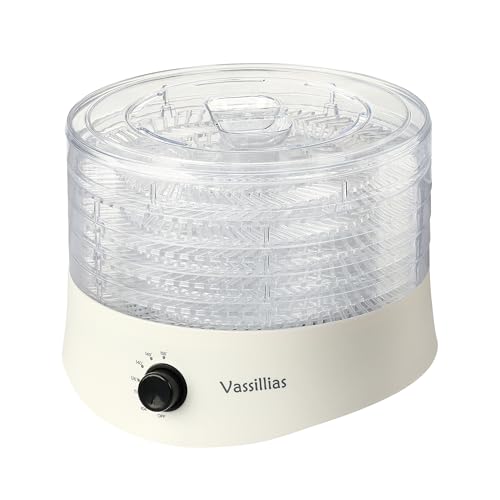
Best for: first-time users who want the lowest price position. Skip it if: you care about a published warranty or weight figure.
The vassillias is the cheapest of the six, and it looks the part. Five stackable trays measure 10.23 x 10.23 in with a 0.79 in gap between layers, and the temperature dial spans 104–158°F. The listing mentions BPA-free food-grade material and an overheating cutoff. That is roughly the same feature list as the FOHERE, minus the digital timer and minus the tighter footprint.
The gaps in the listing are what pull it below the winner. There is no published weight, no published warranty, no noise figure and no wattage in the specifications. For a student buying blind, that is a lot of missing information. It also has the second-highest sales rank of the six, which suggests fewer buyers than the Cosori or Magic Mill picks. Choose it if the price position genuinely matters and you accept the trade-off in published detail.
Pros:
- Lowest price position in this set
- Five trays with a stated 0.79 in gap
- 104–158°F temperature range
- Overheating cutoff per the listing
Cons:
- No published weight in the listing
- No published warranty
- No wattage figure
- Analogue controls, not digital
5. Magic Mill Food Dehydrator Machine — Runner-up
Five stainless steel trays, a 167°F claim and a 240W motor in a 6.06 lb body.
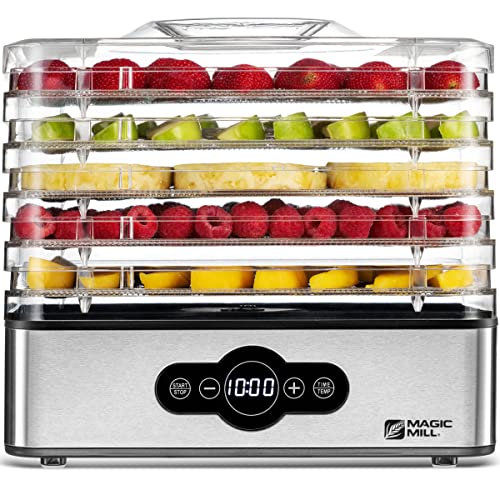
Best for: students who want stainless trays without the premium footprint. Skip it if: you need a published warranty.
Magic Mill sits in an interesting slot. It gives you stainless steel trays and a claimed 167°F ceiling, which is the highest number in the set, but it stays lighter than the premium Cosori at 6.06 lb. Magic Mill quotes 240W for the motor and a 48-hour digital timer. Trays are described as detachable and dishwasher-friendly.
The reasons it lands at number five, not higher, are twofold. The listing does not publish a warranty, which the two Cosori models both do. And the dimensions in the listing read 6.22 x 2.87 x 0.13 in, which is almost certainly a single tray or accessory measurement rather than the full unit, so I cannot compare its footprint directly to the FOHERE or the OSTBA with any confidence. That missing piece hurts it for the student use case, where footprint is often the deciding factor. If you already know it fits your shelf, the stainless trays are a real upgrade over plastic.
Pros:
- Stainless steel trays, five of them
- 167°F ceiling per the listing, highest here
- 6.06 lb, lighter than the premium Cosori
- 48-hour digital timer
Cons:
- Full-unit dimensions unclear in the listing
- No published warranty
- 240W is lower than the FOHERE's 400W
6. OSTBA Food Dehydrator — Best for beginners
Stainless trays, a 400W motor and a 95–160°F range in a 4.18 lb body with a 12-month warranty.

Best for: a first dehydrator with stainless trays and a timer. Skip it if: you want a two-year warranty.
The OSTBA is the closest thing in this set to a straight upgrade over the FOHERE for anyone who prefers stainless trays. The footprint is nearly identical at 8.18 x 8.26 in, weight sits at 4.18 lb, and the temperature range is 95–160°F, two degrees higher than the FOHERE. It has the same 400W motor and a 1–48 hour digital timer with auto shut-off. OSTBA says the embedded stainless trays are dishwasher-safe, and the trays rotate 180° for adjustable spacing.
Two things keep it below the winner. The warranty is 12 months, half the length of what Cosori publishes on its two picks. And it is the slowest seller in this set, which usually means less user feedback out in the wild, though I have no review data to cite. For a first-time buyer who wants the FOHERE's dimensions with metal trays instead of plastic, this is the pick. Everyone else is better served by the FOHERE or the Cosori CFD-N051-W.
Pros:
- 4.18 lb, tied for the lightest here
- Stainless trays with 180° rotation
- 400W motor and 48-hour timer
- 95–160°F temperature range
- 12-month warranty published
Cons:
- Shortest warranty of the picks that publish one
- The slowest seller of the six
- 160°F ceiling still short of 165°F for jerky
What the size figures actually mean on a desk or shelf
Weight and footprint numbers only help if you know what the space you have looks like. Here is how the picks land in real dorm terms.
- A standard dorm desk is about 24 in deep and 42 in wide. The FOHERE (8.66 x 8.27 in) and the OSTBA (8.18 x 8.26 in) occupy roughly the same corner as a boxed cereal package.
- A dorm microwave shelf is usually 15 in deep and 20 in wide. All four of the sub-12-inch picks fit. The premium Cosori (13.5 x 17.8 in) does not, once you leave room for airflow at the rear.
- A studio apartment counter with a toaster and a coffee maker already on it has room for anything up to the Magic Mill or the CFD-N051-W. The CP267-FD needs its own home.
Weight matters for a different reason: lifting the unit down to clean it. At 4.18 to 4.85 lb, the four lightest picks are one-handed. The Magic Mill at 6.06 lb is two-handed if the trays are still in. The premium Cosori at 18.1 lb is a countertop resident, not a shelf resident.
Does a student really need 165°F?
The short answer: only if you plan to make jerky.
Guidance published by USDA sources puts the safe internal temperature for jerky in the 160–165°F range, and dehydrator temperatures need to sit at or above that during the drying phase. Five of the six picks reach 158°F or above; only the two Cosori models and the Magic Mill claim 165°F or higher, with the OSTBA sitting at 160°F.
For everything else students actually dry, the ceiling matters far less:
- Fruit dries well between 125°F and 140°F.
- Vegetables sit in the 125°F to 135°F range.
- Herbs dry at 95°F to 115°F, the low end most of these units hit.
- Yogurt and dough proofing stays under 120°F.
If jerky is on your list, buy the CFD-N051-W. If it is not, the FOHERE's 158°F ceiling does everything you actually need, and paying more for headroom you will not use is the classic mistake in this category.
How loud is a dehydrator with a roommate two feet away?
This is the question the listings answer worst. Only the two Cosori picks publish noise figures: the CFD-N051-W claims below 47 dB, the CP267-FD claims below 48 dB. Both are described as suitable for overnight use.
The other four picks — FOHERE, vassillias, Magic Mill and OSTBA — do not publish decibel figures. That is a real gap for shared-room buyers. A dehydrator runs for four to twelve hours per session; if it sits on the same shelf as a roommate's pillow, the noise matters more than the temperature range.
Practical advice with the data available:
- If quiet is non-negotiable, buy one of the two Cosori picks.
- If it is a preference, the FOHERE lists "quiet operation" in its feature bullets without a number, so treat that as a manufacturer claim and expect to test it in the first week.
- Run the unit in a common area rather than a bedroom whenever the schedule allows. A four-hour herb dry does not need to happen at 2 a.m.
What the listings do not tell you about dorm use
Two things missing from every listing here are worth thinking about before you buy.
Power draw. Dorm outlets often share a circuit with a mini-fridge, a microwave and a hair dryer. The FOHERE and OSTBA both draw 400W; the CP267-FD draws 600W; the Magic Mill draws 240W. Running a 600W dehydrator on the same outlet as a 1,000W microwave will trip the breaker. If you live in older housing, the Magic Mill's lower draw is a quiet advantage.
Storage. A five-tray dehydrator that lives out on the counter is not really a small dehydrator. It becomes one when it stores away. FOHERE mentions an integrated cord wrap; OSTBA mentions cord storage; the others say little. Trays that stack inside the base rather than beside it save shelf inches, and every pick here does that.
None of this is a dealbreaker. It is the kind of detail that turns a good pick into a great one once you know your own space.
The verdict
The best small dehydrator for students is the FOHERE FD-1024. It weighs 4.19 lb, occupies 8.66 x 8.27 in of shelf, gives you five stackable trays with two height settings, and runs a 95–158°F range with a 48-hour digital timer. For the primary student use case — herbs, fruit, vegetable snacks, occasional dog treats — nothing else in this set matches the ratio of what it does to the space it takes.
Two conditions flip that answer. If you plan to make beef jerky more than a few times a year, the 158°F ceiling costs you, and the Cosori CFD-N051-W becomes the right pick: 165°F, a two-year warranty and a sub-47 dB claim in a 4.85 lb body. If you live off-campus with a real kitchen and cook for the week on Sundays, the Cosori CP267-FD's 6.5 ft² of drying space is worth the 18.1 lb footprint.
The vassillias earns its place on price alone; the OSTBA earns its place if you want stainless trays without moving up a price band; the Magic Mill is the pick if the 167°F claim matters and you already know it fits your shelf.
FAQ
Is a small dehydrator worth it for a student?
A small dehydrator is worth it for a student who eats snacks between classes and wants to spend less on packaged fruit, jerky and dried vegetables. Payback depends on how often you use it. At two batches a week, the entry-band picks here justify themselves within a semester. If you dehydrate twice a term, it is not worth the shelf space.
How does the FOHERE compare to the Cosori CFD-N051-W?
The FOHERE compares favourably on footprint and weight: 8.66 x 8.27 in and 4.19 lb, against the Cosori's 11.6 x 11.6 in and 4.85 lb. Cosori wins on temperature ceiling (165°F versus 158°F), on published warranty (two years versus none stated), and on noise claim (sub-47 dB versus unstated). Pick FOHERE for space, Cosori for jerky.
What temperature do I need for beef jerky?
For beef jerky, temperature guidance from US food-safety sources typically falls in the 160–165°F range during drying, following a pre-heat step in some recipes. In this set, only the two Cosori models and the Magic Mill claim to reach 165°F or higher. The OSTBA reaches 160°F, and the FOHERE and vassillias top out at 158°F, below the usual recommendation.
Can I use a dehydrator in a dorm room overnight?
Using a dehydrator in a dorm room overnight is realistic only if noise is low and the appliance is allowed by your housing rules. The two Cosori picks publish sub-48 dB claims and describe overnight use directly. The other four picks do not publish decibel figures, which makes overnight use in a shared room a gamble. Check your housing appliance policy before buying anything.
What is the difference between stainless steel and plastic trays?
The difference between stainless steel and plastic trays comes down to durability, temperature tolerance and cleanup. Stainless resists warping at higher temperatures and does not stain from turmeric or beet juice. The OSTBA, Magic Mill and premium Cosori all use stainless trays; the FOHERE and vassillias use BPA-free plastic. Plastic is lighter and cheaper; stainless lasts longer and looks cleaner after a year of use.
Start with the FOHERE FD-1024 unless a specific reason pushes you elsewhere. The reason to reach past it is almost always jerky, and the Cosori CFD-N051-W handles that with the temperature ceiling and warranty to back it. Everything else in this shortlist solves a narrower problem: the vassillias on price, the OSTBA on stainless trays at the FOHERE's footprint, the Magic Mill on a higher temperature claim, and the premium Cosori on capacity for a full kitchen. Measure your shelf, decide whether jerky matters, then click through to the listing that fits.