Best Small Yogurt Maker for Well-Meaning Newbies

Six compact yogurt makers compared on what a first-timer actually needs: readable controls, a wide temperature range, and jars you won't dread washing. The cewajbaa leads, but three conditions flip the pick.

By Jo LoweryUpdated 15 min read
On this page
- Best small yogurt maker for beginners at a glance
- How I screened these six down
- What actually decides a beginner's first machine
- 1. cewajbaa Probiotic Yogurt Maker with 1-48 Hour Time and — Best overall
- 2. Euro Cuisine YM80 Electric Yogurt Maker Machine — Best for small spaces
- 3. Suteck Yogurt Maker with 8 Jars — Best for families
- 4. JoyMech Yogurt Maker — Best budget pick
- 5. Ultimate Probiotic Yogurt Maker with Adjustable — Best premium
- 6. Bear Yogurt Maker — Best for heavy use
- Single pot or a rack of jars?
- How much counter space does one really take?
- The feature beginners overpay for
- The verdict
- FAQ
The best small yogurt maker for beginners is the cewajbaa Probiotic Yogurt Maker, because its digital control locks a set point across a 68-127°F range and a clear LED display shows the number you picked. If your counter is tight and you'd rather portion yogurt into single-serve jars, the Euro Cuisine YM80 is the better buy at 5.75 x 9.5 x 9.5 in with seven 6oz glass jars. This guide skips the buyers this category isn't for, then names the pick for everyone else.
Best small yogurt maker for beginners at a glance
| Pick | Temp control | Jars or pot | Price |
|---|---|---|---|
Best overall cewajbaa Probiotic Yogurt Maker |
68-127°F, digital | Two 1-quart glass bowls | Check Price |
Best for small spaces Euro Cuisine YM80 |
On/off, fixed | Seven 6oz glass jars | Check Price |
Best for families Suteck Yogurt Maker |
68-131°F claim | Eight 6oz glass jars | Check Price |
Best budget pick JoyMech Yogurt Maker |
Fixed, "constant" claim | One steel container | Check Price |
Best premium Ultimate Probiotic Yogurt Maker |
68-131°F, adjustable | Eight 6oz jars | Check Price |
Best for heavy use Bear Yogurt Maker |
Preset per function | 2 x 33.8 oz + strainer | Check Price |



How I screened these six down
I compared the published specifications for all six side by side. My screen was blunt on purpose, because a beginner's first machine fails in predictable ways.
The picks map to buyer profiles, not to a single score. Here's how each earned a slot:
- The readable-control pick. A first-timer needs to see the temperature and time they set. The cewajbaa and the Ultimate both publish a numeric range you can dial in.
- The small-footprint pick. The Euro Cuisine YM80 publishes the smallest listed footprint at 5.75 x 9.5 x 9.5 in, which matters on a crowded counter.
- The volume pick. The Suteck ships eight 6oz jars, the most portioned servings in the set.
- The lowest-cost entry. The JoyMech is the cheapest of the six, the honest way to test the habit.
- The strain-chaser pick. The Ultimate lists a 68-131°F range, useful for low-temperature cultures.
- The Greek-yogurt pick. The Bear is the only one here that ships a straining mesh.
One caveat up front. "Beginners" is a term Amazon's search treated loosely, and none of these listings promises a guided, foolproof mode. So I read "beginner-friendly" as readable controls plus a forgiving temperature range, and I judged each machine on that.
What actually decides a beginner's first machine
Most yogurt-maker guides compare capacity first. That is not what decides it for a beginner. Temperature you can see and trust is what decides it.
Yogurt cultures in a narrow window. Too cool and it stays soupy. Too warm and the culture dies and you pour out a wasted quart of milk. That wasted quart is the failure mode a first machine has to prevent.
The split in this set is stark. The cewajbaa, the Ultimate and the Suteck publish a numeric range you set and read. The cewajbaa locks between 68-127°F. The Ultimate and Suteck both claim 68-131°F. The other three give you far less to work with.
- The Euro Cuisine YM80 runs on a simple on/off switch with an indicator light and a time reminder, per the listing.
- The JoyMech relies on what its maker calls a "3D Constant Temperature Control System," a fixed set point you cannot read.
- The Bear holds a constant temperature per function but does not publish the numbers.
For a beginner, a readable set point is the safety net. A fixed, invisible temperature works fine once you trust it, but you learn nothing about what went wrong when a batch fails. That is why the cewajbaa leads: it shows you the number.
1. cewajbaa Probiotic Yogurt Maker with 1-48 Hour Time and — Best overall
The cewajbaa is the beginner's pick because it shows you the exact temperature and time you set, so a failed batch teaches you something.
Best for: a first-timer who wants readable controls and room to experiment Skip it if: you want portioned single-serve jars
What sets the cewajbaa apart in this group is the combination of a readable display and a genuinely useful range. The maker says its digital control locks the temperature anywhere from 68-127°F and supports fermentation up to 48 hours. That's a wide window for a beginner to learn in. Cool for a slow, mild set, warmer for a firmer one.
It ships with two 1-quart glass bowls, model SNJ-102A, in black. The listing describes them as BPA-free. A clear top cover lets you watch the ferment without opening it, and cewajbaa says the LED display keeps the process simple. Two 1-quart bowls give you flexibility: one batch of classic and one of a flavour you're testing, side by side.
The trade-off is portioning. Where the jar-based machines hand you seven or eight grab-and-go servings, the cewajbaa gives you two bulk bowls you decant yourself. It's also mid-priced here, not the cheapest way in. For a beginner, the readable controls are worth that.
Pros:
- Digital range spans 68-127°F, per the maker
- Clear LED display shows your set point
- Two 1-quart glass bowls for parallel batches
- Continuous fermentation up to 48 hours claimed
- Transparent cover lets you watch without opening
Cons:
- Two bulk bowls, no portioned single-serve jars
- Only one seller lists it
- Mid-priced, not the cheapest entry point
- No published weight or footprint figures
2. Euro Cuisine YM80 Electric Yogurt Maker Machine — Best for small spaces
The YM80 is the pick when counter space is scarce and you want single-serve jars you can grab from the fridge.
Best for: a tight counter and single-serve portions Skip it if: you want to set a timer and walk away
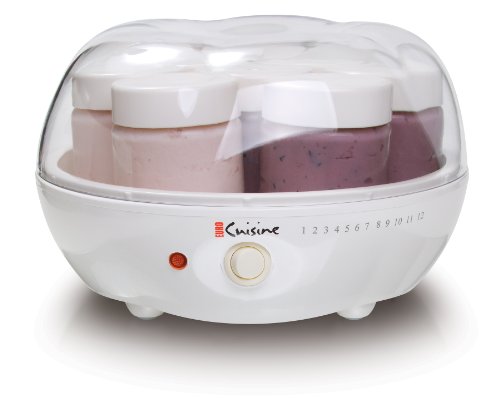
The Euro Cuisine YM80 publishes the numbers that matter for a small kitchen: 5.75 x 9.5 x 9.5 in and 4 lb. That's the smallest listed footprint of the six, and it's light enough to stow in a cabinet between uses. It ships with seven 6oz glass jars, so you can make up to seven different types at once or portion a week of breakfasts.
The controls are deliberately plain. Euro Cuisine describes a clear on/off switch, an indicating light, and a time reminder rather than a programmable timer. For a beginner that simplicity is a mixed blessing: nothing to misread, but nothing to walk away from either. You watch the clock yourself.
Against the cewajbaa, the YM80 trades a readable temperature for a smaller body and portioned jars. If your counter is the constraint, that's the right trade.
Pros:
- Smallest listed footprint at 5.75 x 9.5 x 9.5 in
- Light at 4 lb, easy to store
- Seven 6oz glass jars for portioned servings
- Simple on/off with indicator light
- The second-cheapest of the six
Cons:
- No temperature you can set or read
- Time reminder, not an auto-off timer
- Small jars mean more washing up
- Fewer published specs than the leaders
3. Suteck Yogurt Maker with 8 Jars — Best for families
The Suteck is the family pick because it hands you eight portioned jars and a readable temperature range in one machine.

Best for: a household that eats yogurt daily and wants portioned jars Skip it if: you cook for one or two
The Suteck bridges two things a beginner wants: portioned jars and numbers you can read. It ships eight 6oz glass jars for 48 oz total, the most servings in this set. The maker lists a range of 68-131°F and a timer from 0 to 48 hours with one-touch auto shutoff, so you can set it before bed and wake to finished yogurt.
Suteck describes a food-grade stainless steel shell and BPA-free sealing jars, and claims ±1°C precision plus 25W energy use. It also says the jars are top-rack dishwasher-safe, which matters when you're washing eight of them. For a family eating yogurt daily, that dishwasher line is a real convenience.
The catch is scale. Eight small jars are overkill for one or two people, and you'll rarely fill them. It sits mid-priced here. Against the cewajbaa's two 1-quart bowls, the Suteck trades bulk flexibility for grab-and-go portions.
Pros:
- Eight 6oz jars, 48 oz total, most servings here
- Range claimed at 68-131°F with readable set point
- Timer 0-48h with one-touch auto shutoff
- Jars listed as top-rack dishwasher-safe
- Low 25W draw, per the maker
Cons:
- Eight jars are too many for one or two people
- No published weight or footprint figures
- Precision figures are the maker's claim, unverified
- Mid-priced, above the two entry picks
4. JoyMech Yogurt Maker — Best budget pick
The JoyMech is the cheapest way to test whether yogurt-making becomes a habit before you spend more.
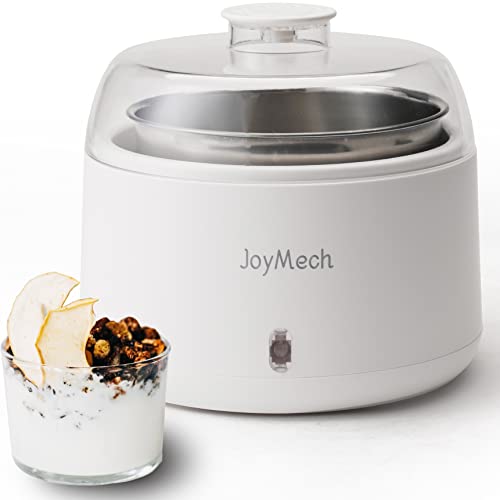
Best for: the cheapest way to test whether you'll stick with it Skip it if: you want a temperature you can read and change
The JoyMech is the cheapest of the six, and that's its whole argument. It uses a single food-grade stainless steel container rather than a rack of glass jars, and the maker says a batch runs 25 to 30 fl oz, enough for a family to share. The instructions are as plain as they come: add whole milk and probiotic powder, plug in, ferment for 12 hours.
JoyMech calls its temperature system a "3D Constant Temperature Control System" and says it ferments evenly for a milder taste. The body is a matte-white BPA-free finish with a transparent cover and an air switch, and the maker notes low energy use and no noise.
For a first machine, the appeal is risk. Spend the least, learn whether you'll keep going. The cost is control: there's no temperature you can see or change, so a failed batch leaves you guessing. Against the cewajbaa, that's the difference between learning and hoping.
Pros:
- The cheapest of the six
- Single stainless container, fewer parts to wash
- 25 to 30 fl oz per batch, per the maker
- Simple three-step process to start
- Quiet, low-energy operation claimed
Cons:
- No temperature you can read or set
- Sparse published specs, generic size and model fields
- One container, no portioned jars
- Only one seller lists it
5. Ultimate Probiotic Yogurt Maker with Adjustable — Best premium
The Ultimate is for someone chasing specific probiotic strains that need a wide, adjustable temperature window.

Best for: someone chasing specific probiotic strains at low temperatures Skip it if: you want the lowest price for a first machine
The Ultimate is the most expensive pick here, and the widest range explains part of that. The maker lists adjustable temperature from 68-131°F and run time up to 48 hours, and pitches it directly at culturing specific species like L. reuteri and L. gasseri, which some recipes ferment at the low end of that window for long stretches.
It ships with eight 6oz jars, weighs 4.41 lb, and measures 5.71 x 14.4 x 7.6 in, so it's the longest body of the group. The finish is stainless steel and the listing calls it 100% BPA-free. It's also the fastest seller of the six here, so this design clearly finds its buyers.
I want to be plain about the health claims: the listing repeats FDA-standard language that these statements are not evaluated and the product is not intended to treat any disease. For a straightforward first batch, you're paying premium for range you may not need. Against the Suteck, it offers similar jars and a similar range at a higher price position.
Pros:
- Adjustable range listed at 68-131°F
- Up to 48-hour run time for long cultures
- Eight 6oz jars for portioned servings
- Published weight and dimensions
- Sells faster than the rest of this set
Cons:
- The most expensive pick here
- Longest body at 14.4 in
- Health-benefit framing leans on unverified claims
- More range than a beginner usually needs
6. Bear Yogurt Maker — Best for heavy use
The Bear is the pick if you want Greek yogurt strained in the same machine that cultures it.
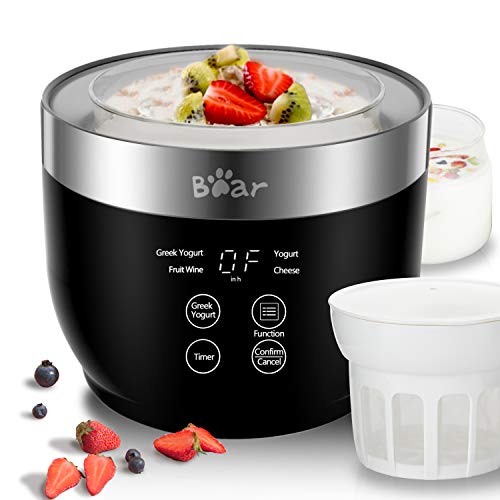
Best for: a maker who wants Greek yogurt strained in the same machine Skip it if: you need a temperature you can set precisely
The Bear is the only machine here that ships a straining mesh, and that's its differentiator. The maker describes a 100-mesh Greek yogurt strainer for manually separating whey, plus a 304 stainless steel inner pot the listing says heats evenly. It's positioned as multifunctional: yogurt, Greek yogurt, cheese, kefir and plant-based yogurt, per the feature notes.
Capacity is generous at 2 x 33.8 oz, and it's light at 3.5 lb. A smart microcomputer timer holds a constant temperature per function, adjustable up to 14 hours. Note the published dimensions read as 72.8 x 76.4 x 76.4 in, which is clearly a listing error rather than a usable figure, so I wouldn't plan a shelf around it.
The real limit for a beginner is temperature. The Bear presets a constant temperature per function rather than letting you dial in a number, so you can't tune a stubborn batch. Against the cewajbaa, you gain a strainer and lose the readable set point.
Pros:
- Only pick here with a Greek-yogurt straining mesh
- 304 stainless inner pot, even heating claimed
- Multifunction: cheese, kefir, plant-based options
- Light at 3.5 lb
- Generous 2 x 33.8 oz capacity
Cons:
- No temperature you can set precisely
- Timer caps at 14h, shortest here
- Published dimensions are clearly erroneous
- Premium price for preset-only control
Single pot or a rack of jars?
This is the format question that trips up first-time buyers, and it splits the set cleanly.
The single-pot machines are the cewajbaa (two 1-quart bowls), the JoyMech (one steel container) and the Bear (2 x 33.8 oz pots). You make one or two larger batches, then decant into your own containers.
The jar machines are the Euro Cuisine YM80 (seven 6oz), the Suteck (eight 6oz) and the Ultimate (eight 6oz). Each jar is a finished portion you grab from the fridge.
Here's the trick most shoppers miss. Jars mean more washing, more often. A pot means fewer parts but one decanting step. For a beginner:
- Choose a pot if you flavour a whole batch the same way and hate small dishes.
- Choose jars if different people want different flavours, or you want portion control.
There's no wrong answer. There's only the one that matches how you'll actually eat it.
How much counter space does one really take?
Only two of the six publish complete footprints, so this section stays honest about what's known.
- Euro Cuisine YM80: 5.75 x 9.5 x 9.5 in, 4 lb. The smallest usable footprint here.
- Ultimate: 5.71 x 14.4 x 7.6 in, 4.41 lb. The longest body, so measure your clearance.
- Bear: listed as 3.5 lb, but its published dimensions are clearly an error and can't be used.
The cewajbaa, JoyMech and Suteck don't publish dimensions at all. In practice, all six are small countertop appliances, not full-size machines. If your counter is the real constraint, the YM80 is the only one with a small footprint you can trust from the listing. Everything else is a judgment call until you can measure it in person. When in doubt, plan for a footprint close to a stand mixer's base and you'll rarely be surprised.
The feature beginners overpay for
The temptation is to buy the widest temperature range and the most jars you can find. Most first-timers don't need either.
Consider what a beginner actually makes: plain and Greek yogurt with a standard culture. That ferments comfortably inside the range every machine here covers. The Ultimate's extra ceiling to 131°F and its strain-specific pitch matter for advanced probiotic recipes, not your first ten batches.
Same with jar count. Eight 6oz jars sounds generous until you're scrubbing eight of them for a household of two. The picks worth paying up for are the ones with readable controls, not the ones with the most parts.
What I'd actually prioritise, in order:
- A temperature you can read and set.
- A timer with auto-off, so a batch can't overrun overnight.
- A jar count matched to your household, not the maximum offered.
Buy for the batches you'll make this month, not the yogurt empire you're picturing.
The verdict
If you're a first-timer who wants to understand what's happening, the cewajbaa Probiotic Yogurt Maker is the pick. Its digital control locks anywhere in the 68-127°F range and its LED display shows you the number, so a failed batch tells you what to change. That readable set point is the beginner's safety net, and no jar count replaces it.
If your kitchen is short on space and you want single-serve jars, the Euro Cuisine YM80 wins instead. At 5.75 x 9.5 x 9.5 in and 4 lb, with seven 6oz glass jars, it's the compact, portioned choice, and its exact advantage over the cewajbaa is footprint plus grab-and-go servings.
The cutoff between them is how you eat yogurt. Make one flavour for the household and decant it yourself, and the cewajbaa's two 1-quart bowls plus readable controls win. Want everyone to grab a different jar from the fridge, and the YM80's seven portions and small body win. For a family that wants both jars and a readable range, the Suteck's eight 6oz jars and 68-131°F claim are the middle path.
FAQ
Is a small yogurt maker worth it for a beginner?
A small yogurt maker is worth it for a beginner if you eat yogurt regularly, because a machine holds the culturing temperature steady where a countertop can't. The cewajbaa's 68-127°F range removes the main reason first batches fail. If you eat yogurt once a month, the habit may not justify even the cheapest pick, the JoyMech.
Is the cewajbaa worth it over the cheaper JoyMech?
The cewajbaa is worth it over the cheaper JoyMech for one reason: you can read and set the temperature. The JoyMech uses a fixed, invisible set point, so a failed batch leaves you guessing. The cewajbaa's digital 68-127°F range and LED display let you diagnose and adjust, which is what a beginner learning the craft actually needs.
What temperature does a beginner yogurt maker need?
A beginner yogurt maker needs a temperature in the standard culturing window, and every machine here covers it. The cewajbaa locks 68-127°F; the Suteck and Ultimate both claim up to 131°F. What matters more than the ceiling is whether you can read the number. Plain and Greek yogurt with a standard culture rarely needs the top of that range.
Should I choose the Euro Cuisine YM80 or the Suteck?
Choose the Euro Cuisine YM80 or the Suteck based on household size and space. The YM80 is smaller at 5.75 x 9.5 x 9.5 in with seven 6oz jars, better for a tight counter. The Suteck offers eight 6oz jars and a readable 68-131°F range, better for a family that wants both portions and control. Space favours the YM80; capacity favours the Suteck.
What mistake do first-time yogurt makers make?
The mistake first-time yogurt makers make is buying for maximum capacity and range instead of readable controls. Eight jars overwhelm a two-person household, and a 131°F ceiling goes unused on standard cultures. Prioritise a temperature you can set, a timer with auto-off, and a jar count that matches how much you'll actually eat each week.
Start by deciding one thing: do you decant a batch or grab a jar? That answer points you to a pot or a rack, and the rest follows. For most beginners the cewajbaa is the right default, because it's the machine that teaches you as you go. You set a visible number, watch the result through a clear cover, and change one thing next time. That feedback loop is what turns a curious first batch into a habit, and it's what the jar-only machines can't give you.