Best Stainless Steel Roti Maker: Puri Press Wins
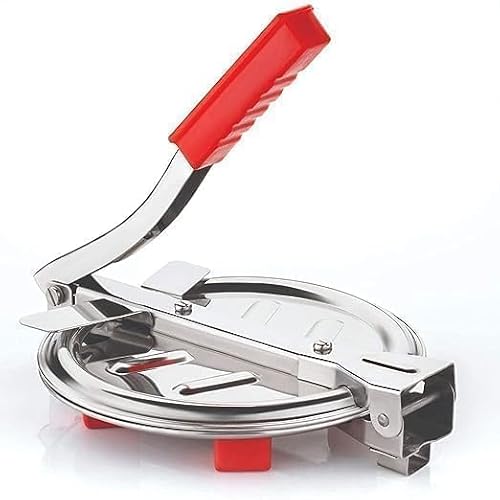
Six stainless steel roti makers compared on weight, plate size and power draw, from an 8 oz hand press to a 46.3 lb automatic machine. Which one actually fits a dorm counter.

By Jo LoweryUpdated 16 min read
On this page
- Best stainless steel roti maker for students at a glance
- How I matched six roti makers to student kitchens
- 1. Generic Puri Press with Handle — Best overall
- 2. Westinghouse WKRM293 Tortilla and Roti Maker — Best upgrade
- 3. EABOSON 10inch Roti Maker Machine — Best for families
- 4. Orixforce 12-Inch Stainless Steel Nonstick Electric — Best compact
- 5. ToolHaven Fully Automatic Roti Maker with Touchscreen — Most versatile
- 6. HMKDQBD Roti Maker — Best premium
- Does a dorm room even allow a stainless steel roti maker?
- Manual press or electric plate: which suits a student budget?
- How much counter and cupboard space do you actually need?
- What the listings leave out
- The verdict
- FAQ
The best stainless steel roti maker for students is the Generic Puri Press with Handle, because at 8 oz and 4 x 4 x 2 in it fits a dorm drawer and never asks for an outlet. If you have a free socket and want the heat handled for you, the Westinghouse WKRM293 is the better buy at 3 lb with an 8-inch plate. Most guides compare wattage first. Wattage is not what decides this.
Best stainless steel roti maker for students at a glance
| Pick | Plate size | Weight | Price |
|---|---|---|---|
Best overall Generic Puri Press with Handle |
7.5-8 in | 8 oz | Check Price |
Best upgrade Westinghouse WKRM293 Tortilla and Roti Maker |
20 cm / 8 in | 3 lb | Check Price |
Best for families EABOSON 10inch Roti Maker Machine |
10 in | Not published | Check Price |
Best compact Orixforce 12-Inch Nonstick Electric |
12 in | 8 lb | Check Price |
Most versatile ToolHaven Fully Automatic Roti Maker |
Standard | 46.3 lb | Check Price |
Best premium HMKDQBD Roti Maker |
Not published | Not published | Check Price |



How I matched six roti makers to student kitchens
I started from the buyer, not the specification sheet. Four profiles came out of it, and each one lands on a different pick.
None of these six listings is described by its maker as a student product. That qualifier comes from the search, not from the packaging. So I treated it as a set of constraints instead: limited counter depth, shared or restricted power, frequent moves, and a budget that has to cover textbooks too. Whether your building allows a countertop cooking appliance is something only your housing contract can tell you.
Here are the four profiles:
- The dorm cook. One shelf, no dedicated outlet, a hot plate or a shared stove down the hall. Needs a tool, not a machine.
- The shared-flat cook. A real kitchen, a spare socket, three or four people. Can host something electric under 10 lb.
- The batch cook. Cooks Sunday for the week. Wants plate diameter above 10 in.
- The house of eight. Permanent counter space and nobody moving out in June.
Profiles 1 and 2 cover most people typing this search. That is why the 8 oz press and the 3 lb Westinghouse lead the ranking, and why the 46.3 lb ToolHaven sits fifth despite being the most capable device in the group.
1. Generic Puri Press with Handle — Best overall
A stainless steel hand press that weighs 8 oz, costs the least of the six, and never competes for an outlet.
Best for: a dorm cook with one shelf and no spare outlet Skip it if: you want the machine to apply the heat
This is the only pick in the set that flattens without electricity, and that single difference makes it the best stainless steel roti maker for students living in restricted housing. The plate measures 7.5-8 in across and the whole unit is 4 x 4 x 2 in folded, so it stores flat under a stack of plates. At 8 oz it adds nothing to a suitcase at the end of term.
The build is stainless steel throughout, and the listing describes it as easy to clean, which for a solid press with no coating and no wiring is the plausible claim in the group. There is nothing to short out and nothing to peel. It is also the cheapest of the six by price position, which matters when the alternative purchase is a whole appliance.
The trade-off is honest and large. You still need a tawa, a hot plate or a stove, because this press shapes dough and stops there. The 8-inch class plate is also the smallest working diameter here, tied with the Westinghouse. Buyers pick it least often of the six, and only one seller lists it.
Pros:
- Lightest pick in the set at 8 oz
- Cheapest of the six
- Needs no outlet or power cord
- Folds to 4 x 4 x 2 in for storage
- Stainless steel with no coating to wear off
Cons:
- Presses dough but applies no heat
- Requires a separate stove or hot plate
- Smallest plate class here, tied at roughly 8 in
- Only one seller lists it
- The slowest seller of the six
2. Westinghouse WKRM293 Tortilla and Roti Maker — Best upgrade
The lightest electric option at 3 lb, with a named brand behind it and an adjustable thermostat.

Best for: a shared flat kitchen with a free socket Skip it if: you need plates wider than 8 inches
Move up one step from the hand press and this is where you land. The WKRM293 weighs 3 lb, which is a third of the Orixforce and a small fraction of the two automatic machines. Its footprint is 7 x 11.8 x 8 in, so it sits beside a kettle rather than replacing it. That combination is rare here: only two picks publish both a weight and a full set of dimensions, and this is the lighter of the two.
It runs at 1000 watts on 120 volt 60 Hz power, the lowest draw of any electric pick in the group, and Westinghouse lists an adjustable thermostat plus a red power light and a green ready light. The housing is stainless steel and the plates are non-stick, with the listing recommending a slightly damp cloth for cleaning. Plate size is 20 cm, which the brand states as 8 inches.
Where it loses is reach. Those 8-inch plates make a smaller roti than the EABOSON's 10 in or the Orixforce's 12 in, so large tortillas and wraps are out. It also holds the second-cheapest position, so it costs more than the hand press while still asking for a socket.
Pros:
- Lightest electric pick at 3 lb
- Lowest power draw of the electric picks at 1000 watts
- Compact 7 x 11.8 x 8 in footprint
- Separate power and ready indicator lights
- Adjustable thermostat and stainless steel housing
Cons:
- 8-inch plates limit roti and tortilla diameter
- No published warranty
- Needs a dedicated outlet in restricted housing
- Only one seller lists it
3. EABOSON 10inch Roti Maker Machine — Best for families
Ten-inch plates and a handle that comes off for storage, and buyers choose it more often than any other electric plate press here.

Best for: four housemates cooking one meal together Skip it if: cupboard space is measured in inches
The EABOSON splits the difference between the Westinghouse and the Orixforce. Its plates measure 10 in, giving you two inches more diameter than the Westinghouse for chapatis, naan and parathas, and it runs at AC 110V 50/60Hz 1200W with a temperature control knob. EABOSON says the housing is stainless steel and that the handle detaches for compact storage, which is the one storage feature no other pick in this group offers.
Buyers reach for this one more often than any other plate-style press in the set, and among the electric picks it is the second-cheapest. Its colour is listed as black rather than bare steel, so it hides fingerprints better than the silver units.
The gap in the data is size. EABOSON publishes no weight and no dimensions, only the 10 in plate figure, so you cannot check whether it clears a shallow cabinet before it arrives. That is a real problem for anyone measuring a dorm shelf. The 1200 watt draw also matches the Orixforce and exceeds the Westinghouse by 200 watts, which is worth knowing on an old circuit shared with a microwave.
Pros:
- 10 in plates, larger than the Westinghouse
- Removable handle for flatter storage
- Adjustable temperature knob
- Second-cheapest of the electric picks
- Chosen more often than the other plate presses here
Cons:
- No published weight or overall dimensions
- Draws 1200 watts on a shared circuit
- No stated warranty
- Only one seller lists it
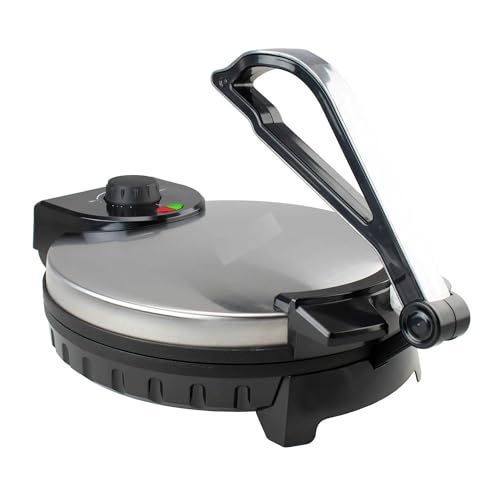
4. Orixforce 12-Inch Stainless Steel Nonstick Electric — Best compact
The widest plate in the set at 12 in, which is the reason to choose it and the reason it is hard to store.
Best for: someone making 12-inch wraps and burritos Skip it if: you carry your kitchen between addresses
Twelve inches is four inches more than the Westinghouse and two more than the EABOSON, and if you make burrito-size tortillas rather than small chapatis, that is the whole argument. Orixforce rates it at 1200W with adjustable heat settings, and lists nonstick aluminium plates inside a stainless steel body, plus power and preheat indicator lights. The colour is given as silver and black.
Price-wise it sits in the middle of the group, above the two entry picks and below the two automatic machines. That makes it a sensible step up for a house that cooks in volume but has no interest in a dough-kneading robot.
Then there's the weight. At 8 lb it is nearly three times the Westinghouse, and the listing publishes no usable overall dimensions, only the plate figure. A 12-inch plate implies a body noticeably wider than 12 inches, and that is a lot of counter for a shared kitchen where four people cook at once. The award label here reflects its footprint relative to the two automatic machines, not to the hand press. Lifting 8 lb in and out of a high cupboard every evening gets old fast.
Pros:
- Widest plates in the set at 12 in
- Adjustable heat settings
- Power and preheat indicator lights
- Nonstick aluminium plates inside a stainless steel body
Cons:
- 8 lb, nearly triple the Westinghouse
- No usable published overall dimensions
- Needs the most counter width of the plate presses
- No stated warranty
- The slowest seller among the electric picks
5. ToolHaven Fully Automatic Roti Maker with Touchscreen — Most versatile
A 46.3 lb stainless steel machine that ToolHaven says takes dry flour to a puffed roti in about 120 seconds.
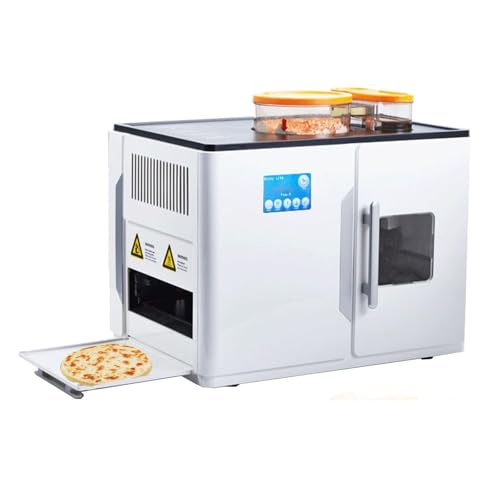
Best for: a large shared house with permanent counter space Skip it if: you move every academic year
This is a different class of device. ToolHaven describes built-in automation that runs the whole sequence from dry flour to finished flatbread in roughly 120 seconds, a touch panel for thickness from 1.0mm upward, a one-click batch of 20 pieces, and a safety cutout that pauses the machine when the front door opens. The listing states a stainless steel main body and covers roti, chapati, tortilla, pancake, pita and dosa. That range is the widest claimed in the group.
It is also the only pick here that publishes both a weight and full dimensions at the large end: 46.3 lb and 18.1 x 21.3 x 16.1 in. Those numbers rule it out of most student housing on their own. Sixteen inches of depth exceeds a standard 24-inch counter's usable space once you allow for a backsplash and a kettle, and 46.3 lb is not a thing you carry down three flights in June.
It holds a premium price position and is filed under bread machines rather than tortilla makers, which is a fair signal of what it really is. Buy it for a house of eight that is not moving.
Pros:
- Widest claimed flatbread range: roti, chapati, tortilla, pancake, pita, dosa
- Touchscreen thickness control from 1.0mm
- Claimed one-click 20-piece batch
- Door-open safety pause
- Full published dimensions and weight
Cons:
- 46.3 lb, the heaviest pick by a wide margin
- 18.1 x 21.3 x 16.1 in swallows a counter
- Premium price position
- Impractical for anyone who relocates yearly
- Only one seller lists it
6. HMKDQBD Roti Maker — Best premium
The most expensive pick here, and the one with the least published specification data.

Best for: a catering-scale kitchen batching flatbreads daily Skip it if: you want published weight and size figures
HMKDQBD makes the same category of claim as the ToolHaven: automated measuring, dispensing, mixing and kneading, a large touch panel controlling thickness from 1.0 mm, roasting time and oil level, a three-layer cooking design, one-button pancake operation, and a stop that triggers when the front door opens. The listing points it at home kitchens, small restaurants and canteens, and states 20 pieces at once.
Buyers pick it more often than any other product in this set, which is notable given its price position. It sits at the top of the group on cost.
What it does not do is tell you what you are buying. The specification list runs to a count of 1 and a model number, A-1. No weight, no dimensions, no plate size, no stated wattage. Every other pick here gives you at least a plate figure. Judging by the ToolHaven's 46.3 lb and 18.1 x 21.3 x 16.1 in, a comparable automatic machine is a permanent counter fixture, but that is inference and not published fact. For a student measuring a shelf, missing numbers are a dealbreaker. That is why it ranks last despite being the pick buyers choose most often here.
Pros:
- Claimed full automation from dry flour to finished roti
- Touch panel for thickness, roasting time and oil level
- Door-open automatic stop
- Stated 20-piece batch capacity
- The one buyers choose most often here
Cons:
- No published weight, dimensions or plate size
- Highest price position with the thinnest published data
- Aimed at restaurants and canteens, not dorms
- No stated warranty
- Only one seller lists it
Does a dorm room even allow a stainless steel roti maker?
This is the question that decides the purchase, and it has nothing to do with the appliance. Read your housing agreement before you read another specification.
Most university residences restrict open-element and high-wattage cooking appliances in individual rooms. The electric picks here draw 1000 watts for the Westinghouse and 1200 watts for both the EABOSON and the Orixforce. On a shared circuit with a microwave and a kettle, that is a tripped breaker waiting to happen, and in a room with a plug-load rule it is a confiscation.
The Generic Puri Press sidesteps all of it. No cord, no wattage, no plug. It is a hand tool, so no plug-load rule applies to it. You supply the heat in a shared kitchen, which is where the rules let you cook anyway.
Three checks before you buy:
- Your contract's appliance clause. Look for a wattage ceiling and a list of banned device types.
- The socket count in your room. One outlet already holding a laptop charger and a lamp is not a spare outlet.
- Where you will actually cook. If it's a communal kitchen down the hall, a portable 8 oz press beats an 8 lb appliance you have to carry there and back.
Nobody in this set markets to students specifically, so none of these appliances has been designed around residence rules. That judgment sits with you.
Manual press or electric plate: which suits a student budget?
The split runs right through the middle of this set, and it is the real deciding criterion for the best stainless steel roti maker for students.
A manual press does one job: it flattens dough into a round. The Generic Puri Press does that with a 7.5-8 in plate and 8 oz of stainless steel. It is the cheapest option here by price position, and its total cost of ownership is the purchase, full stop.
An electric plate press flattens and cooks in one motion. That saves a pan and cuts the learning curve of rolling by hand. The cost is a socket, wattage, a non-stick coating that eventually wears, and a body between 3 lb and 8 lb to store.
Two thresholds are worth naming:
- Under 3 lb, an appliance is portable. Only the 8 oz press and the 3 lb Westinghouse clear that bar.
- Above 10 lb, it lives on the counter forever. The 46.3 lb ToolHaven is firmly there.
If you cook rotis two or three times a week and your kitchen is shared, the press is the smarter buy. If you cook nightly and have a socket you control, the Westinghouse pays for itself in time saved. If you're feeding a house, go to the 10 in EABOSON.
How much counter and cupboard space do you actually need?
Plate diameter is not footprint. The body around the plate adds inches on every side, and that is where students get caught.
Three of these six listings publish full dimensions. The press folds to 4 x 4 x 2 in. The Westinghouse occupies 7 x 11.8 x 8 in, which fits on a shelf beside a bread bin. The ToolHaven needs 18.1 x 21.3 x 16.1 in, deeper than the usable depth of a typical shallow counter once a backsplash and a kettle are accounted for.
The other three publish nothing usable. The EABOSON gives you a 10 in plate and no body size. The Orixforce lists 12 in plates with a dimensions field of zeroes. The HMKDQBD gives neither.
So measure first, in this order:
- Counter depth from wall to edge, minus 2 inches for clearance.
- Cupboard shelf height, because a hinged press opens upward and needs headroom to load.
- The distance from your socket to your work surface, since none of these listings states a cord length.
If your usable depth is under 12 inches, the Westinghouse and the press are your only safe choices from published figures. Everything else is a gamble on numbers that were never printed.
What the listings leave out
Reading six listings side by side, the silences are consistent. Worth knowing before you commit.
- No warranty is published for any of the six. Not the entry picks, not the premium machines. That is unusual across a whole set and it removes a normal tiebreaker.
- No cord lengths. Every electric pick assumes a socket within reach and none says how far that reach is.
- Coating specifics are vague. "Non-stick" appears repeatedly. Only the Orixforce names the plate material, as aluminium under the coating.
- No replacement-part information. For the two automatic machines, with kneading and dispensing mechanisms, that matters more than it does for a solid press.
- Only one seller lists each of the six. Single-source listings limit your options if something arrives damaged.
- Categories are inconsistent. The Generic press is filed under grill presses, the ToolHaven under bread machines, and the other four under tortilla makers. That tells you the category itself is loosely defined on Amazon, so search results mix hand tools with restaurant equipment.
None of this disqualifies a pick. It does mean the specification you can verify carries more weight than the feature bullet you cannot.
The verdict
Entry tier is where most students should stop. The Generic Puri Press with Handle is the best stainless steel roti maker for students on the strength of three published numbers: 8 oz, 4 x 4 x 2 in, and the cheapest position in this set. No cord means no housing-rule conflict and no tripped breaker. Its limitation is real, since it flattens without cooking, so budget for the pan you already own.
Still in the entry tier but a genuine step up, the Westinghouse WKRM293 adds heat for 3 lb and a 7 x 11.8 x 8 in footprint, drawing 1000 watts, the least of any electric pick here. Take it if you control a socket and cook most nights.
The middle tier buys plate diameter. The EABOSON goes to 10 in with a detachable handle, the Orixforce to 12 in at 8 lb. Both are house-share appliances rather than dorm appliances, and neither publishes a body size you can measure against a shelf.
The premium tier buys automation and costs you the counter. The ToolHaven at 46.3 lb and 18.1 x 21.3 x 16.1 in, and the HMKDQBD with no published dimensions at all, are aimed at canteens and large households. Skip both if you relocate every year.
FAQ
Is a stainless steel roti maker worth it for a student?
A stainless steel roti maker is worth it if you eat flatbread more than twice a week, because the alternative is rolling by hand every time. The 8 oz Generic Puri Press is the low-commitment entry: cheapest here, no cord, folds to 4 x 4 x 2 in. Cook less often than that and a rolling pin still wins.
Which is better value, the Puri Press or the Westinghouse?
Better value between the Puri Press and the Westinghouse comes down to your kitchen access. The press is the cheaper of the two and works anywhere, but you supply the heat. The Westinghouse WKRM293 cooks for you at 1000 watts and 3 lb, and needs a socket you control. Restricted housing points to the press.
What plate size do I need for a standard roti?
The plate size you need for standard rotis is around 8 inches, which the Generic Puri Press and the Westinghouse both hit. Step to 10 in with the EABOSON for larger chapatis and naan, or 12 in with the Orixforce for burrito-scale tortillas. Bigger plates mean a bigger body and more counter space.
How much power does an electric roti maker use?
Power draw among these electric roti makers runs from 1000 watts to 1200 watts. The Westinghouse WKRM293 is the lowest at 1000 watts on 120 volt 60 Hz. The EABOSON and Orixforce both draw 1200 watts. On a shared kitchen circuit already running a kettle and microwave, that difference is worth checking against your breaker.
What mistake do first-time roti maker buyers make?
The mistake first-time buyers make is comparing plate diameter and ignoring the body around it. A 12-inch plate sits inside a wider housing, and three of these six listings publish no overall dimensions at all. Measure your counter depth and shelf height first, then shortlist only the picks whose published size actually fits.
Start with your housing contract, not the shortlist. If open cooking appliances are restricted or your room has one shared outlet, the Generic Puri Press with Handle is the only pick here that sidesteps the problem entirely, and at 8 oz it moves with you at the end of every term. If your kitchen is yours to use, the 3 lb Westinghouse WKRM293 adds heat without adding a permanent counter tenant. The two automatic machines are excellent devices in the wrong room. Measure the shelf, then click through and check the current price on whichever one fits.