Best Variable Speed Angle Grinder: SHALL Leads DIY

Six variable speed angle grinders compared on wattage, RPM range, weight and warranty, with a named winner for DIY use and clear conditions for when a different pick wins.

By Jo LoweryUpdated 16 min read
On this page
- Best variable speed angle grinder for diy enthusiasts at a glance
- How I narrowed six grinders from a crowded field
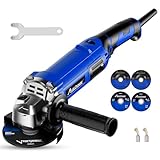
- 1. SHALL Angle Grinder Tool 7.5Amp 4-1/2 Inch — Best overall
- 2. AOBEN 900W Angle Grinder 4-1/2 inch — Best for heavy use
- 3. AVID POWER Angle Grinder 4-1/2 Inch 8.0 Amp 1000W — Best for families
- 4. Makita 9564CV 4-1/2-Inch SJS High-Power Angle Grinder — Best premium
- 5. Metabo HPT Angle Grinder G12VE2 — Best compact
- 6. Hoteche 4-1/2 in Electric Variable Speed Angle Grinder — Best budget pick
- What the speed dial actually changes
- Wattage, RPM and what those numbers hide
- How much does weight really matter on a grinder?
- Which extras earn their space in the box?
- What should a DIY buyer ignore on the spec sheet?
- The verdict
- FAQ
The best variable speed angle grinder for diy enthusiasts is the SHALL 7.5A 4-1/2 inch, which pairs a 12000 RPM top-end with a six-position speed dial and a 1-year warranty at the entry price tier. If you want a longer-life tool with a mechanical clutch and a 2-year warranty, the Makita 9564CV is the better buy at the premium end. The price-band map runs from a sub-750W budget model at the cheapest position to a 13-amp Makita at the top, and the six picks below cover every rung.
Best variable speed angle grinder for diy enthusiasts at a glance
| Pick | Motor | Top RPM | Price |
|---|---|---|---|
Best overall SHALL Angle Grinder 7.5A |
7.5A / 900W | 12000 | Check Price |
Best for heavy use AOBEN 900W 4-1/2 in |
7.5A / 900W | 11000 | Check Price |
Best for families AVID POWER 8.0A 1000W |
8.0A / 1000W | 11500 | Check Price |
Best premium Makita 9564CV SJS |
13A | 10500 | Check Price |
Best compact Metabo HPT G12VE2 |
12A brushless / 1500W | 6-speed dial | Check Price |
Best budget pick Hoteche P800421A |
6.5A / 750W | 6-speed dial | Check Price |




How I narrowed six grinders from a crowded field
The 4-1/2 inch angle grinder is one of the busiest shelves in the power-tool aisle, and most of what sits on it is single-speed. I started with the full 4-1/2 inch class and cut every model that ran at one fixed RPM, because a variable speed dial is the whole point of this comparison.
Three named reasons cut listings from consideration.
- No published variable speed control. A single-speed grinder is a different tool. It grinds well, cuts fine, and burns polishing pads. Out.
- No published motor amperage or wattage. A grinder listing without either figure hides the one specification a buyer can actually compare across brands. Out.
- Duplicate submissions from the same brand at overlapping price positions. One entry per brand keeps the set useful.
What survived is six grinders that each publish a speed range, a motor figure, or both. Two sit at the entry tier, two at the mid tier, and two at the premium tier. The winner is not the cheapest, and it is not the most powerful. It is the one whose published specifications map cleanest to the way a home workshop actually uses a grinder: short bursts across a wide speed range, on mixed materials, with a warranty behind it.
One note on the keyword's DIY qualifier. Amazon's search returned this set for that phrase, but not every product listing calls itself a DIY tool. AOBEN's listing is explicit about DIY projects. Others are marketed at general use. Treat "DIY" as your own judgment call on duty cycle: how many hours a week, on what materials.
1. SHALL Angle Grinder Tool 7.5Amp 4-1/2 Inch — Best overall
A 7.5-amp, six-speed grinder at the entry tier with a full published spec sheet and a 1-year warranty behind it.
Best for: a general DIY workshop tackling metal and wood Skip it if: you need a sub-4-pound tool for overhead work
The SHALL wins on completeness. Its published data covers weight (7.08 lb), dimensions (4.6 x 15.8 x 5.8 in), warranty (1 year) and motor spec (7.5 amps, 900W max output). Only two picks in this set publish a warranty, and this is the cheaper of the two. SHALL says the six-position dial spans 3000 to 12000 RPM, which is the widest range published in the group, and the listing describes swapping the tool between cutting, grinding, polishing and buffing across that range.
Set against the rest: it costs less than four of the other five, ships with two tool-free wheel guards and a non-slip side handle by SHALL's account, and uses the standard 7/8-inch arbor with a 5/8-11 spindle so replacement discs are easy to source. The trade-off is weight. At 7.08 lb it is the heaviest tool here, over three pounds more than the Metabo HPT, and that adds up on long overhead cuts.
Pros:
- Widest published RPM span in the set, 3000 to 12000
- 1-year warranty at the second-cheapest price position
- Two tool-free wheel guards included by the listing
- Standard 7/8-inch arbor and 5/8-11 spindle
- Full weight, dimension and model figures published
Cons:
- Heaviest tool in the set at 7.08 lb
- Motor is brushed, not brushless like the Metabo HPT
- No mechanical clutch, unlike the Makita 9564CV
2. AOBEN 900W Angle Grinder 4-1/2 inch — Best for heavy use
A 7.5-amp six-speed grinder whose listing calls out a switch lock for extended cutting and grinding sessions.

Best for: longer cutting and grinding sessions with a switch lock Skip it if: you want a full published spec sheet before buying
The AOBEN reads like a close cousin of the SHALL on paper: same 7.5-amp draw, same 900W output, six-speed adjustable control, a 4-1/2 inch wheel with a 7/8-inch arbor and 5/8-11 spindle. Two things separate them. AOBEN publishes an 11000 RPM top-end where SHALL publishes 12000, and AOBEN's listing highlights a switch lock designed to hold the trigger during longer runs. That single feature is why it earns the heavy-use label here, though the sales figures show it sells faster than the SHALL in this set.
Set against the rest: it is the only pick whose marketing text is explicit about DIY use, which matters when the keyword's qualifier is only partly supported by the raw listings. The trade-off is transparency. AOBEN's published spec panel is thin, with a colour and a model number but no weight, no dimensions and no warranty. Buyers who read spec sheets before they buy will find less to check.
Pros:
- Six-speed dial with switch-lock feature per the listing
- Standard 7/8-inch arbor and 5/8-11 spindle
- Listing text explicit about DIY use cases
- Sells faster than most others in this set
Cons:
- No published weight, dimensions or warranty
- Top-end RPM lower than the SHALL by 1000
- Same wattage as a cheaper pick in this set
3. AVID POWER Angle Grinder 4-1/2 Inch 8.0 Amp 1000W — Best for families
The only pick with a paddle switch and lock-on button, and the highest published wattage under the brushless tier.

Best for: shared-shop use where a paddle switch feels safer Skip it if: you want the highest published top-end RPM
AVID POWER's 8.0-amp motor and 1000W output are the strongest figures in the brushed group here, and the seven-speed dial spans 3000 to 11500 RPM by the listing. A paddle switch that shuts off the moment your hand lets go is a genuine safety difference from the standard slider on the SHALL and the Hoteche. In a shared shop where more than one person picks up the tool, that matters.
Set against the rest: at 4.19 lb it is the second-lightest pick, well under the SHALL's 7.08 lb but heavier than the Metabo HPT's 3.75 lb. Dimensions are compact at 3.94 x 13.6 x 2.95 in. The listing includes two cutting wheels, two metal grinding wheels, a lock nut wrench, a side handle and a spare pair of carbon brushes, which is the fullest accessory kit in the set. The trade-off is popularity: this one sells the slowest of the mid-tier picks, and there is no published warranty to fall back on.
Pros:
- Only pick with a paddle switch and lock-on button
- Second-lightest tool in the set at 4.19 lb
- Seven variable speeds, one more than most
- Full accessory kit with spare carbon brushes
Cons:
- No stated warranty on the listing
- Slower seller than the AOBEN or SHALL
- Top-end RPM below the SHALL's 12000
4. Makita 9564CV 4-1/2-Inch SJS High-Power Angle Grinder — Best premium
A 13-amp grinder with a mechanical clutch, soft start, constant speed control and a 2-year warranty.

Best for: the DIYer who plans to keep one grinder for a decade Skip it if: you rarely reach for a grinder and want to spend little
The Makita is the most expensive pick here and it earns the position with specifications the entry tier does not publish. Makita says the 13-amp motor runs 2800 to 10500 RPM, and the listing describes four features the cheaper picks do not: an SJS mechanical clutch that lets the drive shaft slip if the wheel binds, constant speed control that applies extra power under load, soft start, and a variable speed dial that matches speed to application. The published 2-year warranty is twice the SHALL's coverage and is the longest in the set.
Set against the rest: at 6 lb it sits between the SHALL and the AVID POWER on weight, and its 6 x 16 x 6 in body is the bulkiest here. The top-end RPM is actually lower than every other pick, and that is deliberate on a grinder built to hold its rated speed under load. The trade-off is straightforward. You pay the premium price band for a clutch, a soft start and a warranty, not for a bigger number on the dial.
Pros:
- Longest published warranty in the set at 2 years
- Mechanical SJS clutch to protect motor and gears
- Soft start and constant speed control listed
- 13-amp motor, the largest in the group
Cons:
- Most expensive pick in this set
- Bulkiest dimensions at 6 x 16 x 6 in
- Lower top-end RPM than every other pick
5. Metabo HPT Angle Grinder G12VE2 — Best compact
A 3.75-pound brushless grinder with a 12-amp motor and a tool-less wheel guard.

Best for: tight spaces and long jobs where weight fatigues the wrist Skip it if: you prefer a brushed motor at a lower price position
The Metabo HPT is the lightest tool here by a wide margin. At 3.75 lb it is a full 3.33 lb under the SHALL and 2.25 lb under the Makita, and its 4.8 x 12.2 x 2.2 in body is the slimmest in the group. The AC brushless motor is what makes that weight possible, and Metabo HPT's listing calls out three consequences: highly efficient grinding, minimal maintenance, and reduced tool size. Six speed settings and a 1500W maximum output are published, plus a tool-less wheel guard with a quick-release lever and an inverter circuit that smooths generator power.
Set against the rest: it is the only brushless motor in the group, which usually means longer service life for the same duty cycle. The trade-offs matter for a value-focused DIY buyer. Its sales rank is the slowest here by a large margin, and no warranty is published on the listing. On paper it is the most modern tool in the set, but you are paying premium tier prices for the brushless technology.
Pros:
- Lightest tool in the set at 3.75 lb
- Only brushless motor in the group
- Tool-less wheel guard with quick-release lever
- 1500W maximum output per the listing
Cons:
- No published warranty
- Slowest-selling pick in this set
- Premium price for a brand less common in home shops
6. Hoteche 4-1/2 in Electric Variable Speed Angle Grinder — Best budget pick
The cheapest of the six, with a six-position dial and a ball bearing motor at 6.5 amps.

Best for: an occasional user who wants variable speed at the entry tier Skip it if: you plan to use it weekly for hours at a time
The Hoteche is the cheapest of the six and the only one drawing 6.5 amps rather than 7.5 or more. Power consumption is 750W, roughly 17% below the SHALL and AOBEN and a quarter under the AVID POWER. Hoteche's listing calls out a ball bearing motor, an aluminum gear housing, a spindle lock for wheel changes and a lock-on switch. The variable dial runs from a minimum through positions 1 through 5 to a maximum, though no RPM figures are printed on the listing.
Set against the rest: for a buyer who reaches for a grinder a few times a year, a lower-wattage tool with variable speed is a defensible pick, and the 5/8-11 shaft arbor accepts the same discs as the more expensive tools. The trade-offs are real. Sales rank on this pick is the slowest in the group, no weight or warranty figures are published, and the power cord is only 6 ft long, shorter than most workshop layouts want.
Pros:
- Cheapest of the six by price rank
- Ball bearing motor and aluminum gear housing
- Standard 5/8-11 shaft arbor for common discs
- Spindle lock and lock-on switch included
Cons:
- No published RPM figures, only dial positions
- No weight or warranty stated
- 6 ft power cord is short for larger shops
- Slowest sales rank in the group
What the speed dial actually changes
A variable speed dial does not exist so you can grind faster. It exists so you can grind different materials at different speeds without changing tools. Below roughly 5000 RPM, the wheel is slow enough for polishing pads and wire wheels on paint or rust. In the middle band, grinding wheels remove metal without burning it. At full speed, cut-off discs do what they are built for.
Every pick in this set publishes a speed range or a speed count.
- Widest published range: SHALL at 3000 to 12000 RPM
- Highest speed count: AVID POWER with seven positions
- Lowest published top-end: Makita at 10500 RPM, deliberately geared for load stability
- Undeclared range: Hoteche and Metabo HPT publish position counts but not RPM figures
If you plan to buff or polish, a low end near 3000 RPM matters more than the top end. Most polishing compounds burn above 4000 RPM, so a grinder that only steps down to 6000 is a grinder that cannot really polish.
Wattage, RPM and what those numbers hide
A grinder listing that shouts about RPM is telling you the no-load speed, which is what the tool spins at with nothing touching the wheel. Under load, every grinder slows down. The Makita's constant speed control is designed to counter that; brushed motors without it slow more.
Wattage is a truer read on how much material a grinder can move per minute. Ranked in this set:
- Metabo HPT: 1500W maximum output
- AVID POWER: 1000W with an 8.0-amp draw
- SHALL: 900W with a 7.5-amp draw
- AOBEN: 900W with a 7.5-amp draw
- Makita: 13-amp motor, wattage not stated
- Hoteche: 750W with a 6.5-amp draw
Amperage is the other side of the same coin. A 13-amp Makita will draw more from a wall circuit than a 6.5-amp Hoteche, so extension cords and shared outlets factor in. On a 15-amp shop circuit, the Makita leaves less headroom for a shop vac running at the same time.
How much does weight really matter on a grinder?
How much does weight really matter on this class of tool depends on how you hold it. Overhead work, one-handed detail work, and long cut lists punish a heavy grinder. Bench work on horizontal stock forgives it, because the tool rests on the workpiece.
Ranked lightest to heaviest in this set:
- Metabo HPT: 3.75 lb
- AVID POWER: 4.19 lb
- Makita 9564CV: 6 lb
- SHALL: 7.08 lb
- AOBEN and Hoteche: not published
The spread between the lightest and heaviest published figures is 3.33 lb, roughly a factor of 1.9. That gap shows up after twenty minutes of overhead work as arm fatigue and a wandering cut line. If most of your grinding happens on a bench, the SHALL's weight is a non-issue. If most of it happens on a stepladder, the Metabo HPT earns its price. The AVID POWER is the practical compromise, close to the compact class in weight without the brushless price premium.
Which extras earn their space in the box?
Most of these grinders ship with extras. Some are useful, some are filler.
Worth having:
- Spare carbon brushes. AVID POWER includes a pair. Brushes wear, and having spares in the box saves a trip when the motor starts sparking.
- Multiple wheel guards. SHALL includes two tool-free guards for cutting and grinding. Swapping guards is safer than running the wrong guard.
- Spindle lock and spindle wrench. Every pick in this set has both. This is the baseline.
- A side handle with two mounting positions. SHALL's listing mentions this specifically.
Filler at this class:
- A single 4-1/2 inch cutting or grinding wheel. Most of these ship with one or two, and both wear out in an afternoon. Buy a ten-pack of the disc type you actually use.
- A cardboard "storage case". It will be recycling within a week.
The Makita ships with the fewest accessories. That reflects the segment: buyers of a premium grinder usually own their preferred discs already.
What should a DIY buyer ignore on the spec sheet?
A DIY buyer should ignore three numbers that professional buyers watch closely.
- Peak power vs. rated power. A 1500W maximum output figure is a spike, not a sustained rating. On a home circuit for short bursts, sustained wattage is what matters, and none of these listings publish it.
- Duty cycle in minutes. Industrial grinder specs quote a run-rest ratio. Home-shop use rarely stresses a tool long enough for this to bite.
- Vibration damping figures. Useful on the jobsite where a worker holds the tool for hours. On a home project, hearing protection and eye protection matter more.
What a DIY buyer should read carefully:
- Warranty length. Two picks publish one, and the Makita's 2 years is twice the SHALL's 1 year.
- Weight and dimensions. Handling comfort decides whether the tool comes off the shelf.
- Speed range in RPM, not just position count. A six-position dial that spans 3000 to 12000 RPM is a different animal from a six-position dial with no range printed.
- Standard arbor and spindle threads. All six here use 7/8-inch arbors and 5/8-11 spindles, so discs are interchangeable.
The verdict
The SHALL 7.5A 4-1/2 inch is the winner because it publishes the fullest spec sheet in the entry tier and pairs a 3000 to 12000 RPM range with a 1-year warranty. For a DIY workshop that reaches for a grinder a few times a month across mixed materials, that combination is hard to argue with at the second-cheapest price position in this set. Two picks flip the recommendation.
If you expect to keep the tool for a decade and run longer sessions on tougher stock, the Makita 9564CV is the better buy. Its 13-amp motor, mechanical clutch, soft start, constant speed control and 2-year warranty are specifications the entry tier does not offer, and it costs the most here for exactly those reasons.
If most of your work is overhead, on a ladder, or in confined spaces, the Metabo HPT G12VE2 wins on weight. At 3.75 lb it is 3.33 lb lighter than the SHALL, and its brushless motor is the only one in the set. The cutoff is duty cycle: under an hour a week of light work, the SHALL is enough. Over that, and mostly on hard materials, the Makita earns the premium.
FAQ
Is a variable speed angle grinder worth it for DIY use?
A variable speed angle grinder is worth it for DIY use if you plan to do more than one job with the tool. A single-speed model cuts and grinds fine, but a variable dial lets one tool cover polishing, buffing, wire-wheeling and cutting by slowing the wheel to match the material. Every pick in this set publishes at least six speed positions.
What is the difference between the SHALL and the AOBEN grinders?
The difference between the SHALL and the AOBEN comes down to published data and one feature. Both draw 7.5 amps at 900W with six speeds and a 4-1/2 inch wheel. SHALL publishes 12000 RPM top-end, weight, dimensions and a 1-year warranty. AOBEN publishes 11000 RPM top-end and a switch lock for extended runs, but no weight, dimensions or warranty.
How many RPM does a DIY angle grinder actually need?
How many RPM a DIY angle grinder needs depends on the disc. Cutoff wheels run best near their rated maximum, usually 12000 to 13000 RPM on a 4-1/2 inch wheel. Grinding wheels work between 6000 and 10000 RPM. Polishing pads burn above 4000. A variable dial that spans 3000 to 12000, like the SHALL's, covers every case in one tool.
Do I need a brushless motor for a home shop angle grinder?
You do not need a brushless motor for a home shop unless you plan to run the tool hard for hours at a time. Brushless motors, like the Metabo HPT's AC brushless in this set, last longer and weigh less, but they cost more. A brushed motor with fresh carbon brushes, like AVID POWER's kit that includes spares, handles occasional DIY work for years.
What should I avoid when buying a variable speed angle grinder?
What you should avoid when buying a variable speed angle grinder is a listing that publishes speed positions without publishing an RPM range. A six-position dial means nothing if you cannot see what the top and bottom positions actually spin at. Also avoid grinders without a published warranty if you plan to use the tool weekly, and avoid non-standard arbor sizes that limit disc choice.
The right way to choose here is to name your duty cycle first and let it pick the tier. Most home shops sit inside the entry tier's comfort zone, which is why the SHALL wins by default: it publishes enough data to trust, covers the full speed range a mixed-material workshop asks for, and comes in at a price position that leaves budget for good discs and a face shield. If your projects run longer or higher, step up to the Makita for the clutch and the warranty, or to the Metabo HPT if the tool spends more time above your head than in front of you. Buy a ten-pack of your usual disc type with whichever grinder you choose, and keep the spare carbon brushes on the shelf.