Best Yogurt Maker for Daily Use by Capacity
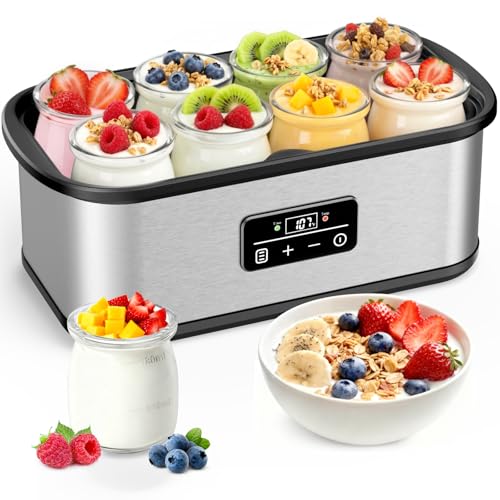
Six yogurt makers compared on capacity, temperature control, and jar count. The cewajbaa SNJ-102A leads with eight 6oz jars and a 68-127°F range.

By Jo LoweryUpdated 14 min read
On this page
- Best yogurt maker for daily use at a glance
- How I screened the shortlist
- The specification that actually decides daily use
- 1. cewajbaa SNJ-102A — Best overall
- 2. Euro Cuisine YM80 — Best for families
- 3. Kaaeiccr ZHU-011 — Best budget pick
- 4. Euro Cuisine YMX650 — Most versatile
- 5. TANICA YOGURTiA YS02GW-U — Best premium
- 6. theMilkman Incubator — Best upgrade
- Jar count, capacity, and how a week of yogurt actually stacks up
- Does a wider temperature range matter?
- What the listings do not tell you
- The verdict
- FAQ
The best yogurt maker for daily use is the cewajbaa SNJ-102A, because eight 6oz jars and a 68-127°F range let you portion a week of breakfasts and dial in the exact culture temperature. If you want the simplest controls and a smaller footprint, the Euro Cuisine YM80 wins with seven 6oz jars and a single-switch operation. Both weigh around 4 lb, so counter storage is not the deciding factor.
Best yogurt maker for daily use at a glance
| Pick | Jars / capacity | Temperature control | Price |
|---|---|---|---|
Best overall cewajbaa SNJ-102A |
8 × 6oz glass | 68-127°F, 48h timer | Check Price |
Best for families Euro Cuisine YM80 |
7 × 6oz glass | On/off, time reminder | Check Price |
Best budget pick Kaaeiccr ZHU-011 |
2 × 10oz glass | Adjustable temp + timer | Check Price |
Most versatile Euro Cuisine YMX650 |
7 × 6oz glass, dated lids | Digital, set temperature | Check Price |
Best premium TANICA YOGURTiA YS02GW-U |
2 glass pots | 77-158°F in 1° steps | Check Price |
Best upgrade theMilkman Incubator |
1 × ½ gallon | Non-electric, 10h hold | Check Price |


How I screened the shortlist
I started with every yogurt maker listed under Specialty Appliances and cut down using the data on the pages. Three filters did most of the work.
- Published temperature or timing data. A daily-use appliance needs a stated control range. Machines that named neither a temperature nor a fermentation window were out.
- Clear capacity. I need to know how much yogurt one run produces. Listings that only said "family size" without a jar count or volume were cut.
- A defined culture container. Glass jars, glass pots, or a stainless vessel. Vague "included accessories" without a material or size lost.
That left the six here. They split cleanly by capacity: four multi-jar sets for portioned breakfasts, one two-jar unit for a couple or a solo eater, and one large single-vessel incubator for people who batch cook. The best yogurt maker for daily use has to match how you actually eat yogurt, and that starts with jar count.
One caveat on the search term. Amazon's results for "daily use" were not filtered by any daily-use feature. I treated the qualifier as a shopping consideration you have to judge yourself, not a certified attribute.
The specification that actually decides daily use
Most yogurt-maker guides compare wattage or a vague "digital" label. That is not what decides it for a daily habit. The deciding specification is jars per batch times batch time against your eating rate.
Here is the arithmetic. If two people eat one 6oz cup each morning, that is 14 cups a week. A seven-jar maker like the Euro Cuisine YM80 covers one person for a week per batch. An eight-jar unit like the cewajbaa SNJ-102A stretches to eight breakfasts, which lines up neatly with a weekend-to-weekend rhythm plus one spare. A two-jar Kaaeiccr covers a couple for a single day.
The best yogurt maker for daily use, then, is the one whose single-batch output matches how often you are willing to start a new run. Most fermentations take 6-12 hours. If you can only face setting up a batch every 5-7 days, you need at least seven jars or a half-gallon vessel. Under-buy the capacity and you stop making yogurt within a month.
Temperature range matters second. It matters, but it decides variety, not frequency.
1. cewajbaa SNJ-102A — Best overall
Eight 6oz jars plus a 68-127°F range give the best yogurt maker for daily use its edge: a full week of portioned breakfasts with room for one experimental flavour.
Best for: a household eating yogurt most mornings and rotating flavours Skip it if: you want a single large batch rather than portioned jars
Within this set, the cewajbaa is the only maker combining eight jars with a stated temperature range. The Euro Cuisine YM80 gives you seven jars but no adjustable temperature. The TANICA gives you 1° control but only two pots. The cewajbaa splits the difference. Manufacturer copy says it runs up to 48 hours, which covers the long, slow ferments some vegan bases and thicker yogurts want, and cewajbaa claims the LED display shows fermentation progress through a clear top cover.
At 4.21 lb it is the second-heaviest here after the Euro Cuisine YMX650, which is still light enough to move between cupboard and counter. The eight jars are dishwasher-safe according to the listing. This is the one buyers choose most often across the six.
The trade-off: no published warranty, unlike the Euro Cuisine YMX650, and the model number is buried in the specs rather than the title.
Pros:
- Eight 6oz glass jars, the highest jar count in the set
- 68-127°F temperature control, adjustable
- 48-hour timer covers long ferments
- LED display and clear top cover per the listing
- The fastest seller of the six
Cons:
- No stated warranty on the listing
- Silver finish only, no colour options published
- Jars are 6oz, smaller than the Kaaeiccr's 10oz glasses
2. Euro Cuisine YM80 — Best for families
Seven 6oz jars, a plain on/off switch, and a 4 lb body make the YM80 the pick when you want simple, repeatable batches for a family that shares yogurt.
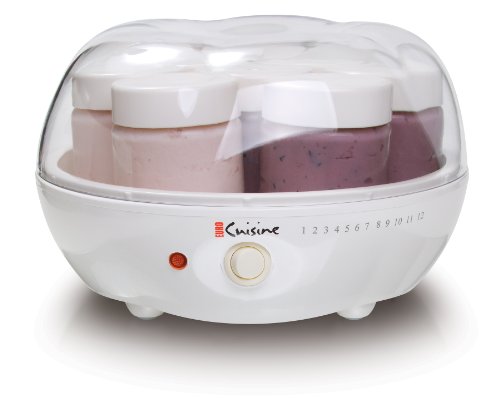
Best for: a family that wants seven individual jars and simple controls Skip it if: you want digital temperature control
The YM80 is the second-cheapest of the six and the only sub-mid-priced multi-jar maker here. It measures 5.75 x 9.5 x 9.5 in, so it fits inside the same footprint as a stand mixer base. Euro Cuisine says the controls are one on/off switch with an indicator light and a time reminder, which is the shortest learning curve in this set.
What you give up is temperature control. The YM80 runs at a fixed incubation temperature that Euro Cuisine does not publish on this listing. That is fine for standard dairy yogurt and Greek-style straining, and it is the reason the machine is so simple. It is not fine if you want to explore cooler ferments or higher-temperature cultures.
Compared with the eight-jar cewajbaa, you lose one jar and the ability to dial temperature. Compared with the pricier YMX650 from the same brand, you lose the digital timer and the dated lids. Two sellers list it, which is the joint-highest offer count here.
Pros:
- Seven 6oz glass jars for portioned servings
- Simplest controls in the set: on/off plus timer light
- 4 lb, the lightest multi-jar maker here
- Compact 5.75 x 9.5 x 9.5 in footprint
Cons:
- No adjustable temperature on the listing
- No digital display or set-and-forget timer
- No stated warranty published
3. Kaaeiccr ZHU-011 — Best budget pick
The cheapest of the six pairs two 10oz glasses with adjustable temperature and a timer, which is the smallest sensible daily-use footprint for one or two people.

Best for: a solo eater making two flavours at a time Skip it if: you need to feed more than two people
The Kaaeiccr is the cheapest pick in the set and the only one that pairs two jars with both a temperature dial and a timer. Those two 10oz glasses actually deliver more total volume than a two-cup single vessel would, and 10oz is closer to a satisfying single serving than the 6oz jars in the Euro Cuisine and cewajbaa lineups.
Kaaeiccr says the housing is BPA-free with food-grade stainless steel, and the machine shuts off automatically at the end of the fermentation window. The listed body dimensions are 10.24 x 8.26 x 4.72 in, and the low height matters: it slides under a standard 18-inch wall cabinet with room to spare.
The reality check: this is the slowest seller of the six. Two jars is a real constraint. If you eat yogurt daily and want to make it every three days, this is your maker. If you want a week of jars ready in the fridge, buy something else.
Pros:
- Two 10oz glasses, the largest jar volume here
- Adjustable temperature plus timer
- Low 4.72 in profile fits under upper cabinets
- BPA-free stainless housing per the listing
Cons:
- Only two jars per batch
- No published weight or warranty
- The slowest seller of the six
4. Euro Cuisine YMX650 — Most versatile
A three-year warranty, seven dated lids, and a digital set-and-forget timer make this the pick when you want the machine to outlast the habit.
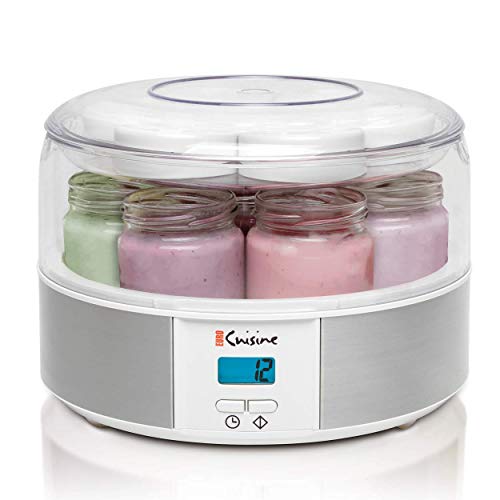
Best for: a buyer who values a stated warranty and dated lids Skip it if: you already have enough jars and want the lowest price
The YMX650 is the only pick here with a published warranty: three years, listed in the specifications. It is also the largest at 8 x 12 x 12 in and the joint-heaviest at 4 lb. Euro Cuisine says it works by heating 42oz of milk with a starter culture, then holding temperature through the timer. The dated lids are the quiet win: each lid has a rotary date wheel so you know which jar is oldest without labelling anything.
Compared with the YM80 from the same brand, you gain the digital display, the set temperature control, and the warranty, and you pay more for it. Compared with the cewajbaa, you lose one jar and a lower price position, and you gain the three-year cover and the dated lids.
Two sellers list it. The stainless-look finish shows fingerprints, which the listing photos make clear.
Pros:
- Three-year manufacturer warranty, the only one in the set
- Seven 6oz jars with dated rotary lids
- Digital display with set temperature
- Wide 8 x 12 x 12 in body suits a fixed counter spot
Cons:
- Premium price band, second-highest here
- Largest footprint in the set
- Stainless finish shows marks
5. TANICA YOGURTiA YS02GW-U — Best premium
Precise 1° temperature steps from 77-158°F make this the pick if you ferment miso, natto, and amazake alongside yogurt.

Best for: a fermenter working across yogurt, natto, miso, and amazake Skip it if: you only ever make plain dairy yogurt
The TANICA is the most expensive pick here and the smallest at 7.4 x 6.3 x 6.3 in. At 1.87 lb it weighs less than half of every other electric maker in the set. TANICA says the microcomputer holds the temperature to 1°F increments across the 77-158°F range, which is a wider ceiling than any other pick here and the reason it doubles as a natto and amazake incubator. Two glass pots come in the box along with a recipe book.
For plain daily yogurt, this is overkill. For a cook who wants to run a batch of natto at one temperature and yogurt at another, the range and the precision earn their keep. TANICA notes the unit accepts 100-240V, which is unusual for the US market and means it travels.
The trade-off is stark: two pots against the cewajbaa's eight jars, and the highest price position of the six for the smallest single-batch capacity in the electric group.
Pros:
- 1° temperature control from 77-158°F, per the manufacturer
- Widest temperature ceiling in the set
- 1.87 lb, the lightest pick here
- Two glass pots plus a recipe book included
- 100-240V worldwide voltage
Cons:
- Highest price position in the set
- Only two pots per batch
- No stated warranty
6. theMilkman Incubator — Best upgrade
A half-gallon stainless vessel that holds fermentation temperature for up to 10 hours without a plug: one big batch, no electronics to break.

Best for: someone who wants one large batch and no plug on the counter Skip it if: you want set-and-forget electric timing
theMilkman is the outlier here. It is not electric. The manufacturer says it holds temperature for up to 10 hours during incubation, which covers most yogurt cultures and some slow ferments. The vessel is stainless steel with a wide mouth for easy scooping and cleaning. Half a gallon is 64oz, which beats every other pick in this set on single-batch volume: it produces roughly the same yogurt as 10 of the 6oz jars in the multi-jar makers.
The pitch is durability and countertop presence. There is no display to fail, no timer to reset, no jars to break. You heat your milk on the stove, culture it, seal the incubator, and open it in the morning. That is the whole workflow.
The trade-off against the cewajbaa is real: you lose portioning and any temperature adjustment, and you have to warm the vessel correctly at the start because the incubator holds temperature, it does not generate it. This is the slowest seller of the six by a wide margin.
Pros:
- ½-gallon capacity, the largest single batch here
- Non-electric, no display to fail
- Wide-mouth stainless steel body
- Holds temperature for up to 10 hours per the listing
Cons:
- Requires pre-heating and correct starting temperature
- No portioning into jars
- No timer, no display, no adjustable temperature
- Slowest seller in the set
Jar count, capacity, and how a week of yogurt actually stacks up
Line the six picks up by single-batch output and the daily-use picture gets simple.
- cewajbaa SNJ-102A: 8 × 6oz = 48oz total
- Euro Cuisine YM80: 7 × 6oz = 42oz total
- Euro Cuisine YMX650: 7 × 6oz = 42oz total, 42oz milk input per the listing
- Kaaeiccr ZHU-011: 2 × 10oz = 20oz total
- TANICA YOGURTiA: 2 glass pots
- theMilkman: ½ gallon = 64oz total
For one person eating a 6oz cup daily, the cewajbaa runs eight days per batch and the two Euro Cuisines run seven. For a couple at 12oz combined daily, the cewajbaa runs four days, the seven-jar makers 3.5 days, and the Kaaeiccr under two. The best yogurt maker for daily use in a two-person household is one of the top three, and the ranking barely changes between them.
For a family of four eating 6oz each, you are running two batches a week on any multi-jar unit, or one and a half batches on theMilkman. That is when the half-gallon incubator becomes tempting: fewer setups, less washing up.
Does a wider temperature range matter?
For plain daily yogurt, temperature range matters less than jar count. Every pick with a stated range covers the standard 100-115°F fermentation window that most dairy cultures want. Where the wider range on the TANICA (77-158°F) and cewajbaa (68-127°F) earns its keep is variety.
Lower temperatures around 77-90°F suit vegan yogurts on cashew, coconut, or soy bases, where the cultures ferment more slowly than dairy strains. Higher temperatures up to the 130-140°F band suit some traditional cultures and are the reason the TANICA can double as a natto or amazake incubator. If you want to explore that ground, buy for the range. If you want plain dairy yogurt every morning, buy for the jar count and the timer.
The best yogurt maker for daily use for a strictly dairy household is the seven- or eight-jar multi-jar unit. The best yogurt maker for daily use across a wider fermentation repertoire is the TANICA.
What the listings do not tell you
A few things worth knowing before you buy any yogurt maker in this set:
- Milk quality decides thickness more than the machine. Whole milk with a splash of cream yields the thickest set. Ultra-pasteurised milk sets more loosely than standard pasteurised milk. No machine here fixes a thin base.
- Culture matters. A tablespoon of live-culture store yogurt works as a starter for the first few batches. Freeze-dried starters give more consistent results long term.
- Straining is a separate step. Making Greek yogurt means straining the finished product through cheesecloth or a nut-milk bag for 2-4 hours. None of these machines strain.
- Jars break. Every glass-jar maker in this set includes glass, and replacement jars are not always available from the same brand. Standard 6oz canning jars fit most of them.
- The fermentation itself is nearly silent. The Kaaeiccr listing mentions quiet operation; in truth, none of these machines have moving parts once the batch starts.
The verdict
The best yogurt maker for daily use is the cewajbaa SNJ-102A. Eight 6oz jars, 68-127°F temperature control, and a 48-hour timer cover a full week of breakfasts for one person, four days for a couple, and every fermentation window you are likely to try. It is also the fastest-selling pick in this set, which is a signal that other buyers reached the same conclusion.
The runner-up is the Euro Cuisine YM80, and the condition that flips it is simplicity. If you do not want any dial or display, and you want seven jars for less than the cewajbaa, the YM80 is the shorter learning curve. You lose one jar and the temperature control, and you gain a one-switch machine that will not confuse anyone in the house.
Two edge cases. If you already own enough jars and want a stated warranty, the Euro Cuisine YMX650 is the only pick here with published cover: three years. If you ferment beyond yogurt into natto, miso, and amazake, the TANICA YOGURTiA earns its higher price with 1° precision from 77-158°F.
FAQ
Is a yogurt maker worth it for daily use?
A yogurt maker is worth it for daily use when you eat more than about four 6oz cups a week. A multi-jar maker like the cewajbaa produces 48oz per batch, which is a week of breakfasts for one person. The savings compound over months. If you only eat yogurt occasionally, the countertop space is not worth it.
How does the cewajbaa SNJ-102A compare with the Euro Cuisine YM80?
The cewajbaa SNJ-102A compares with the Euro Cuisine YM80 on three points: one more jar (eight against seven), adjustable temperature from 68-127°F against a fixed range, and a 48-hour timer against a simple on/off switch. The YM80 costs less and is easier to use. The cewajbaa handles more variety and a longer weekly cycle.
What temperature does yogurt need to ferment?
The temperature yogurt needs to ferment sits between roughly 100°F and 115°F for standard dairy cultures. Every pick here with a stated range covers that window. Vegan yogurts on nut and coconut milk often ferment lower, around 77-90°F, which is why the TANICA's 77-158°F range and the cewajbaa's 68-127°F range matter for wider fermentation.
How many jars do I actually need?
How many jars you need depends on your eating rate and how often you will start a batch. One person at 6oz daily needs seven jars for a weekly batch, so the Euro Cuisine YM80 or cewajbaa SNJ-102A both work. A couple needs eight to fourteen jars a week, which means the cewajbaa or theMilkman's half-gallon vessel.
What is the biggest mistake first-time buyers make?
The biggest mistake first-time buyers make is under-buying the capacity. A two-jar machine looks affordable, but making yogurt every second day gets old fast, and most people stop using the machine within a month. Buy enough capacity to cover four to seven days of eating per batch. The cewajbaa's eight jars is the sweet spot for most households.
Start with the cewajbaa SNJ-102A if you eat yogurt more mornings than not. Eight jars covers most of a week, the 68-127°F range handles dairy and plant bases, and the 48-hour timer covers every reasonable fermentation window. If simpler is better, drop to the Euro Cuisine YM80 and lose one jar. If you want fermentation beyond yogurt, step up to the TANICA. The point of making yogurt at home is that the machine disappears into the routine, and the machine that disappears fastest is the one that matches how much you actually eat.