Best Bench Grinders for Home Projects by Wheel Size

Seven bench grinders compared on wheel size, motor pull and tool rest quality, with a named winner, a budget alternative and the profiles that flip the pick.

By Jo LoweryUpdated 17 min read
On this page
- How I narrowed seven listings to the picks that matter
- Best bench grinder for home projects at a glance
- 1. DEWALT DW758 8-Inch Bench Grinder — Best overall
- 2. WEN BG4276 6-Inch Single Speed Bench Grinder — Runner-up
- 3. WEN BG625V 2.5-Amp 6-Inch Variable Speed Bench Grinder — Best for heavy use
- 4. VEVOR 8-inch Bench Grinder — Best for families
- 5. Woodskil 6" 1/2HP High Speed Bench Grinder — Most versatile
- 6. VEVOR Bench Buffer Polisher — Best budget pick
- 7. OPAVIOC Jewelry Polisher — Best for beginners
- 6-inch or 8-inch: which wheel size fits home projects?
- What decides a bench grinder, and what to ignore
- Are polisher-buffers really bench grinders?
- What to check before you bolt one down
- The verdict
- FAQ
The best bench grinder for home projects is the DEWALT DW758, an 8-inch machine with a 3/4 HP induction motor that spins at 3,600 rpm, mounted on a cast iron base that will not walk across a bench when you lean into a lawnmower blade. If your bench is tight or your work is smaller, the WEN BG4276 is the better buy: a 6-inch, 2.1-amp grinder with a flexible work light and a two-year warranty.
How I narrowed seven listings to the picks that matter
Seven listings came in, and they do not all belong to the same tool. Four are true bench grinders with paired abrasive wheels. Two are jewellery buffer-polishers wearing "bench grinder" in the title. One sits between: a small buffer with a fibre wheel that can grind, sort of.
I sorted them by three criteria, in this order:
- Wheel size and motor rating. This decides how much steel you can actually remove.
- Base weight and construction. A grinder that skips across the bench is dangerous, not just annoying.
- Included accessories that a beginner needs on day one: eye guards, tool rests, both a coarse and a fine wheel.
The best bench grinder for home projects has to survive infrequent, heavy use. Home shops are not workshops. A machine sits idle for weeks, then grinds a mower blade for twenty minutes on a Saturday. That duty cycle rewards a heavy cast-iron base and an induction motor over a lightweight universal one.
Three picks got cut from the top spots because their wheel diameter, base weight or accessory bundle put them out of the running for general shop grinding, though they earn places lower down for the buyers they do suit. The full ranking is in the table.
Best bench grinder for home projects at a glance
| Pick | Wheel & motor | Weight | Price |
|---|---|---|---|
Best overall DEWALT DW758 8-Inch Bench Grinder |
8 in, 3/4 HP induction 3,600 rpm claim |
7.76 oz listed | Check Price |
Runner-up WEN BG4276 6-Inch Single Speed |
6 in, 2.1 A 3,450 rpm claim |
16 lb | Check Price |
Best for heavy use WEN BG625V 6-Inch Variable Speed |
6 in, 2.5 A 2,000–3,400 rpm claim |
not listed | Check Price |
Best for families VEVOR 8-inch Single Speed |
8 in, 4.5 A 3/4 HP claim 3,450 rpm claim |
25.8 lb | Check Price |
Most versatile Woodskil 6" 1/2HP |
6 in, 1/2 HP 2.8 A claim 3,450 rpm claim |
17 lb | Check Price |
Best budget pick VEVOR Bench Buffer Polisher |
polisher-buffer 3,590 rpm claim |
5.5 lb | Check Price |
Best for beginners OPAVIOC Jewelry Polisher |
polisher-buffer variable speed |
7.19 lb | Check Price |




1. DEWALT DW758 8-Inch Bench Grinder — Best overall
A cast iron 8-inch grinder with a 3/4 HP induction motor is the default answer for a home shop that grinds real steel.
Best for: a home shop that sharpens mower blades, chisels and drill bits Skip it if: your bench is short on depth or you rarely grind steel
The DW758 wins on the two things that decide a bench grinder for home projects: wheel diameter and motor type. DEWALT lists a 3/4 HP induction motor turning the 8-inch wheels at 3,600 rpm, and an induction motor holds its speed under load in a way a universal motor in a light 6-inch grinder does not. That matters the moment you lean a mower blade into the wheel. The 8-inch wheels also give you a flatter grind on a curved edge and a longer service life before the wheel is used up.
The cast iron base and motor housing are the reason this model has stayed on shelves for so long. Precision-machined aluminium tool rests let you set a repeatable angle, and rear exhaust ports vent grinding dust away from the wheel guards.
The trade-off is footprint and price position. This is the most expensive pick here and the largest, at 10.8 by 17.8 by 12.6 inches. If your bench is a folding trestle in a garage corner, that footprint is real.
Pros:
- 3/4 HP induction motor claim, best in this set
- 8-inch wheels for flatter grinds and longer wheel life
- Cast iron base and housing
- Precision-machined aluminium tool rests
- Rear exhaust ports vent dust from the wheel area
Cons:
- Most expensive pick in this set
- Largest footprint at 10.8 x 17.8 x 12.6 in
- No published warranty in the listing
- Only two sellers list it
2. WEN BG4276 6-Inch Single Speed Bench Grinder — Runner-up
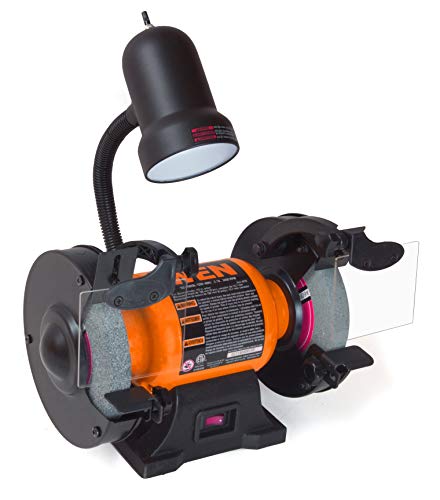
A 6-inch grinder with a flexible work light and a two-year warranty, at the entry price band of this set.
Best for: weekend DIY sharpening on a compact bench Skip it if: you want variable speed for softer metals
The BG4276 is the pick when the DW758 is more grinder than you need or more bench than you have. WEN lists a 2.1-amp motor turning 6 by 3/4 inch wheels at up to 3,450 rpm, with a 36-grit wheel for shaping and a 60-grit wheel for finer work. Adjustable eye guards are included, and the flexible gooseneck work light is the one accessory on any 6-inch grinder in this set that a beginner will actually miss on a cheaper model.
At 16 lb, it is heavy enough to sit steady when bolted down but light enough to move on and off a bench. Dimensions are 15 by 14 by 9.8 inches, tighter than the DEWALT in every direction.
WEN publishes a two-year warranty on this model. Only the two WEN picks in this set do. Against the 8-inch DEWALT you give up wheel diameter and the induction motor, so the BG4276 is the runner-up rather than the winner: for a first grinder or a small bench, that trade is easy.
Pros:
- 6 by 3/4 inch wheels with both 36-grit and 60-grit included
- Flexible work light built into the tool
- Two-year warranty published on the listing
- Entry price band in this set
- Adjustable eye guards included
Cons:
- Universal motor rather than induction
- Single fixed speed
- Smaller 6-inch wheels wear faster than 8-inch
- Tool rests are basic
3. WEN BG625V 2.5-Amp 6-Inch Variable Speed Bench Grinder — Best for heavy use
Variable speed is the reason to spend more on a 6-inch grinder, and this one runs from 2,000 to 3,400 rpm.

Best for: reviving old tools and knives where speed control matters Skip it if: you only ever grind mild steel at full speed
The BG625V is the same shape of tool as the BG4276 with two things added: a 2.5-amp motor and a speed dial that WEN says runs from 2,000 to 3,400 rpm. That range is why this earns the heavy-use label rather than the runner-up spot. Slower speeds keep the edge cool when you are sharpening a plane iron or a carving knife, and full speed is there for shaping.
WEN pairs an 80-grit wheel with a 36-grit wheel here rather than the 60-grit and 36-grit on the cheaper BG4276, and adds pivoting tool rests that adjust more finely than fixed rests. The flexible work light and two-year warranty carry over. Dimensions are 17.3 by 15.4 by 9.65 inches, wider than the BG4276 and taller than the DW758 in one direction.
Against the DEWALT, this is still a 6-inch grinder with a universal motor. Under sustained load on hard steel, the induction motor on the DW758 will hold its speed better. The BG625V beats it on finesse and on published warranty, but not on brute grinding.
Pros:
- Variable 2,000 to 3,400 rpm range claim
- Pivoting tool rests for finer angle setting
- 80-grit fine wheel included, better for edges
- Two-year warranty published
- Flexible work light
Cons:
- Weight not listed on the product page
- Universal motor, not induction
- Premium price for a 6-inch grinder
- Slowest seller of the six true grinders in this set
4. VEVOR 8-inch Bench Grinder — Best for families
An 8-inch grinder at the entry price band, heavy enough to stay put at 25.8 lb.

Best for: a shared garage where two adults sharpen garden tools Skip it if: you plan to mount it on a lightweight folding bench
The VEVOR 8-inch is the only other 8-inch grinder in this set and the cheapest way to get to that wheel size. VEVOR lists a 550W, 4.5A induction motor claim at 3,450 rpm, with 36-grit and 60-grit brown fused alumina wheels included. That is a similar spec sheet to the DEWALT on paper.
At 25.8 lb, this is the heaviest tool in the set, and weight is a virtue on a grinder: a die-cast aluminium base and heavy-duty steel plate body reduce wobble when a mower blade catches. The transparent eye shield adjusts through several angles and the tool rest adjusts without tools, which is the sort of detail a shared shop appreciates when two people set up differently.
Where it loses to the DW758 is track record and the fact that features here are manufacturer claims rather than the long-published DEWALT spec. Only one seller lists it. If you want an 8-inch grinder and cannot spend at the premium band, this is the sensible pick. If you can, the DEWALT is the safer buy.
Pros:
- 8-inch wheels at an entry-tier price position
- 25.8 lb, heaviest in this set for stability
- Both 36-grit and 60-grit wheels included
- Tool-free adjustable work rest
- Adjustable transparent eye shield
Cons:
- Induction motor is a listing claim, not verified
- Sales rank leads the true grinders here but no track record
- No published warranty on the listing
- Only one seller stocks it
5. Woodskil 6" 1/2HP High Speed Bench Grinder — Most versatile
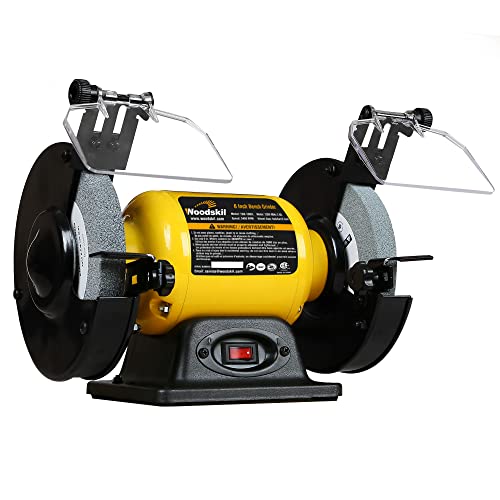
A CSA-listed 6-inch grinder with a coarse and fine wheel pairing aimed squarely at sharpening.
Best for: knife and chisel sharpening on a smaller footprint Skip it if: you need an 8-inch wheel for larger blade radii
The Woodskil TDS-150CL-A is the outlier in the set: a 6-inch grinder that Woodskil positions specifically for sharpening rather than general grinding. The listing describes a 1/2 HP 2.8A motor at 3,450 rpm and a 6 by 3/4 by 1/2 inch wheel size, paired with 36-grit and 60-grit aluminium oxide wheels. Dimensions come in at 9.14 by 12.4 by 9.53 inches and weight at 17 lb, tighter than either 8-inch pick.
Two details set it apart from the two WEN grinders. Woodskil says the base is pre-drilled and rigid steel, which matters for bolting to a workbench. And the listing carries a CSA certification, one of two safety marks referenced in the whole set. A transparent eye shield and spark arrestor are called out too.
Against the WEN 6-inch pair, Woodskil trades the built-in work light and published warranty for the CSA listing and a slightly higher motor rating claim. If sharpening is what you actually do most, that trade favours this one.
Pros:
- CSA-listed on the product page
- 1/2 HP motor claim, higher than the 2.1 A WEN
- Pre-drilled steel base for bench mounting
- Coarse and fine aluminium oxide wheels included
- Transparent eye shield and spark arrestor
Cons:
- No work light
- No published warranty
- Premium price band for a 6-inch grinder
- Only one seller lists it
6. VEVOR Bench Buffer Polisher — Best budget pick
Cheapest in the set, but a polisher-buffer with abrasive attachments rather than a bench grinder.

Best for: jewellery, small parts and polishing rather than steel grinding Skip it if: you actually need to sharpen a lawnmower blade
Be honest with yourself before buying this one. The VEVOR bench buffer is the cheapest of the seven and by far the lightest at 5.5 lb, with a compact 6.61 by 6.37 by 5.15 inch footprint. VEVOR describes a brushless motor at 3,590 rpm and bundles a wool wheel, a fibre wheel and a grinding wheel with a hundred sculpting accessories. That accessory pack is the reason it earns a place here.
For its actual job — polishing jewellery, cleaning up small metal parts, light rust removal, buffing after sanding — it is a competent, tidy tool. Brushless motors run quieter and last longer than brushed ones, which is a real advantage for detail work at the bench.
What it is not is a bench grinder for home projects in the everyday sense. There is no cast iron base, no 6-inch abrasive wheel pair, no proper tool rest. If your "home projects" mean fine work, this is fine. If they mean garden tools, buy one of the four true grinders above.
Pros:
- Cheapest of the seven
- Brushless motor, quieter than brushed
- 100-piece accessory kit for varied small work
- Compact 5.5 lb, easy to store
- Transparent debris deflector
Cons:
- Not a bench grinder in the everyday sense
- No true tool rest for angle sharpening
- Wheel size not comparable to a 6-inch or 8-inch grinder
- No published warranty
7. OPAVIOC Jewelry Polisher — Best for beginners
A variable-speed buffer for jewellery and detail work, sold plainly for what it is.

Best for: a first buffer for polishing and light rust removal Skip it if: you want a true grinder for shop tools
The OPAVIOC SY320 sits in the same category as the VEVOR buffer but with a more honest listing. It is described as a jewellery polisher and dental buffer, weighs 7.19 lb, and measures 5.5 by 5 by 13 inches. Variable speed is the reason it earns the beginner tag: slower speeds for cotton polishing wheels, higher speeds for the abrasive fibre wheels included with rust removal in mind.
The bundle is six 4-inch cotton wheels, two fibre wheels and a polishing compound, which is enough to do useful work out of the box. For someone who has never used any kind of buffer or grinder, a variable-speed machine at low starting speeds is the safer place to begin.
Its weakness is the same as the VEVOR buffer's: this is not a bench grinder. It sits in this roundup because it appears in the same search, not because it competes with the DEWALT. If you know you want to polish and refine, start here. If you want to sharpen a chisel, do not.
Pros:
- Variable speed useful for cotton and fibre wheels
- Complete polishing bundle included
- Compact 7.19 lb footprint
- Straightforward listing for a beginner
- Suits jewellery and detail work
Cons:
- Not a bench grinder
- No abrasive stone wheels for edge grinding
- No published warranty
- Slowest seller in this set
6-inch or 8-inch: which wheel size fits home projects?
Wheel diameter is the single decision that shapes everything else about your grinder. In this set, three picks run 8-inch wheels and three run 6-inch, with two buffer-polishers outside that scale.
An 8-inch wheel gives you a flatter grind on a curved edge, because a larger radius produces a shallower hollow. That matters for chisels, plane irons and lawnmower blades, and it matters less for drill bits and small tools. An 8-inch wheel also lasts longer before it is used up, since there is more abrasive to wear away.
A 6-inch wheel is easier to fit on a small bench, cheaper to replace, and pairs with a lighter motor. If your bench is a folding trestle in a garage corner, or if you already own an angle grinder for anything big, a 6-inch grinder like the WEN BG4276 covers real home use.
The cutoff is bench depth. A tool at 17.8 inches deep, like the DEWALT, needs at least 20 inches of bench clearance with the wheel guards. Below that, go with a 6-inch grinder like the WEN BG4276 or the Woodskil.
What decides a bench grinder, and what to ignore
Most guides compare rpm figures. That is not what decides a bench grinder. All four true grinders in this set claim between 3,400 and 3,600 rpm, and the difference between those numbers at the wheel is invisible in your hand.
Here is what actually decides it.
- Motor type. An induction motor holds speed under load; a universal motor slows down. The DEWALT calls out induction explicitly. The two WEN grinders are amp-rated rather than horsepower-rated, which is a soft hint of universal construction.
- Base weight. A grinder skipping across the bench is the failure mode. The VEVOR 8-inch is 25.8 lb, the Woodskil 17 lb, the WEN BG4276 16 lb. Anything under 15 lb needs bolting down before first use.
- Tool rest quality. Precision-machined rests, like DEWALT's aluminium ones or the WEN BG625V's pivoting rests, let you set and hold a repeatable angle. Stamped-steel rests wobble.
- Wheel bundle. A coarse wheel for shaping and a fine wheel for edges is the minimum. Every true grinder here includes both.
Ignore rpm within this range, ignore work lights unless you grind in a dim space, and treat "3/4 HP" claims on universal motors as marketing rather than physics.
Are polisher-buffers really bench grinders?
Two picks in this set — the VEVOR buffer and the OPAVIOC polisher — are listed as bench grinders on Amazon but are polishing machines in practice. It is a common category overlap and worth naming plainly.
A bench grinder pairs two abrasive stone wheels on a fixed-speed motor with tool rests, and its job is to remove metal quickly. A polisher-buffer pairs cotton or fibre wheels on a variable-speed motor, and its job is to smooth, polish or lightly clean.
They look similar. They do different work. A buffer will not sharpen a chisel, and a grinder will not polish a ring. If a "bench grinder" in a search result weighs 5.5 lb and comes with cotton wheels, it is a buffer. That is fine if buffing is what you need; both picks here are competent buffers. It is not fine if you thought you were buying a grinder.
The tell in the specifications: look for stated wheel size in inches paired with grit numbers. A true grinder lists "6-inch, 36-grit and 60-grit" or "8-inch, 36-grit and 60-grit". A buffer lists cotton, wool, fibre or compound.
What to check before you bolt one down
Before you power on a new bench grinder, do these five things in order.
- Bolt the base to the bench. Every true grinder here has mounting holes, and the Woodskil listing says its base is pre-drilled. A 16 lb grinder walking sideways under load is a real hazard.
- Set the tool rest gap to about 1/16 inch from the wheel. Any wider and a workpiece can wedge between the rest and the wheel.
- Set the spark deflector or eye guard so sparks are directed away from you and downward.
- Dress the wheels flat with a wheel dresser before first serious use. Wheels can arrive slightly out of round, and running them that way is where vibration starts.
- Wear safety glasses on top of the guard, always. The transparent eye shields on these tools are a second line of defence, not a substitute.
The Woodskil is the only pick here with a CSA listing called out on the product page. That does not make the others unsafe, but it does mean the Woodskil has been assessed against a Canadian safety standard, which is worth knowing.
The verdict
The best bench grinder for home projects is the DEWALT DW758 if you have the bench for it, and the WEN BG4276 if you do not. Two conditions flip that answer.
If you sharpen more than you grind — knives, plane irons, chisels, carving tools — the WEN BG625V is worth the step up from the BG4276 for its 2,000 to 3,400 rpm variable range. Slower speeds keep an edge cooler, and cooler edges hold their temper. That single spec matters more than any other for edge work.
If you cannot spend at the premium band but want the 8-inch wheel size, the VEVOR 8-inch is the sensible entry-tier route to that diameter, at 25.8 lb of bench-holding weight. You give up the DEWALT's track record and the WEN warranty, and you rely on manufacturer claims for the induction motor spec.
The Woodskil earns its place for sharpening-first buyers on a smaller bench, thanks to the CSA listing and 1/2 HP motor claim. The two buffer-polishers are honest recommendations for buffing and polishing work, not for grinding. Match the tool to the job, not the search term.
FAQ
Is a bench grinder worth it for home use?
A bench grinder is worth it for home use if you sharpen tools more than twice a year. A 6-inch model like the WEN BG4276 pays for itself the first time you resharpen a lawnmower blade instead of replacing it. Below that frequency, a good hand file or a sharpening stone does the same work with less shop space.
6-inch or 8-inch bench grinder for a home garage?
Choose 6-inch or 8-inch by bench depth first, wheel life second. A 6-inch grinder like the WEN BG4276 fits a bench 12 inches deep and suits knives, drill bits and small tools. An 8-inch grinder like the DEWALT DW758 needs 20 inches of clearance and rewards you with flatter grinds on lawnmower blades and longer wheel life.
DEWALT DW758 vs WEN BG4276: which one should I buy?
DEWALT DW758 vs WEN BG4276 comes down to wheel size, motor and price band. The DW758 has 8-inch wheels, a 3/4 HP induction motor and a cast iron base at the premium price. The BG4276 has 6-inch wheels, a 2.1-amp motor, a flexible work light and a two-year warranty at entry price. Buy the DEWALT for heavy grinding, the WEN for weekend sharpening.
What speed should a bench grinder for home projects run at?
Speed on a bench grinder for home projects is fine anywhere in the 3,400 to 3,600 rpm range for general steel work. What matters more is whether the motor holds that speed under load. Induction motors, like the DEWALT DW758's, hold speed better. For softer metals or heat-sensitive edges, the WEN BG625V's 2,000 rpm low end is the useful feature.
What common mistakes ruin a new bench grinder?
Common mistakes with a new bench grinder are running it unbolted, leaving the tool rest gap wider than 1/16 inch, and skipping wheel dressing. An unbolted grinder walks under load. A wide rest gap can jam a workpiece. Undressed wheels vibrate and grind unevenly. Fix all three in the first ten minutes of ownership and the tool will outlast the wheels.
Bolt the DEWALT DW758 to the deepest, heaviest bench you have, dress both wheels before the first serious job, and set your tool rests to the shallow angle you actually want to grind. That is the whole setup. What earns it the top spot in this roundup is nothing exotic: an induction motor, an 8-inch wheel, a cast iron base and precision tool rests, in a design that has stayed on shelves because it does the one job a bench grinder for home projects has to do. If the bench is smaller or the budget tighter, the WEN BG4276 is the honest step down, not a compromise.