Best Budget Bench Grinder for Beginners by Wheel Size
Six bench grinders lined up spec by spec, with a clear winner for first-time buyers and honest notes on where each one loses ground.

By Jo LoweryUpdated 16 min read
On this page
- Best budget bench grinder for beginners at a glance
- How I narrowed the field to six
- 6-inch or 8-inch: which wheel size should a beginner pick?
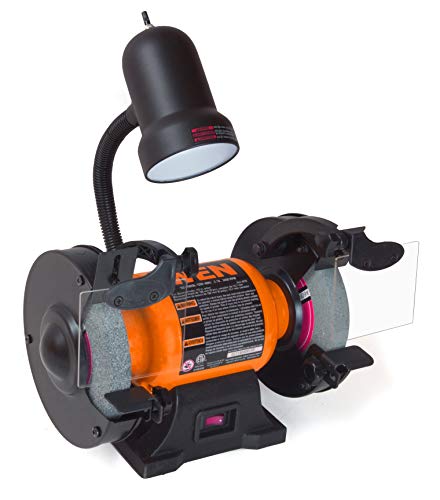
- 1. WEN BG4276 — Best overall
- 2. DEWALT DW758 — Best premium
- 3. WEN BG4260 — Best budget pick
- 4. VEVOR MD150 — Runner-up
- 5. Greteefor NS-SLJ-01-3 — Best for beginners
- 6. Bucktool TLG-150S — Best for heavy use
- Why RPM matters more than horsepower on paper
- What the listings do not tell you
- What more money actually buys in this set
- Setup and safety a first-timer should not skip
- The verdict
- FAQ
The best budget bench grinder for beginners is the WEN BG4276, a 16 lb 6-inch single-speed grinder with a 2.1-amp motor spinning to 3450 RPM, a flexible work light, and a two-year warranty. If you want variable speed and a heavier cast-iron base to grow into, the Greteefor NS-SLJ-01-3 at 38.1 lb runs from 1725 to 3450 RPM and takes over. Everything else in this roundup slots between those two poles.
Best budget bench grinder for beginners at a glance
| Pick | Wheel & speed | Weight | Price |
|---|---|---|---|
Best overall WEN BG4276 |
6 in, 3450 RPM | 16 lb | Check Price |
Best premium DEWALT DW758 |
8 in, 3600 RPM | cast iron body | Check Price |
Best budget pick WEN BG4260 |
6 in, 3450 RPM | 14 lb | Check Price |
Runner-up VEVOR MD150 |
6 in, 3450 RPM | 18.7 lb | Check Price |
Best for beginners Greteefor NS-SLJ-01-3 |
6 in, 1725–3450 RPM | 38.1 lb | Check Price |
Best for heavy use Bucktool TLG-150S |
6 in, 1750 RPM claim | 22.4 lb | Check Price |



A quick word on the keyword. Amazon's own filter treats "beginners" as a soft hint, not a strict filter, so none of these grinders is formally marketed to first-timers. What I did instead was line up the specifications a beginner actually has to live with: wheel size, RPM, weight, warranty and included accessories. The picks below are the ones that made that list read well.
How I narrowed the field to six
I started with the full Bench Grinders category and cut hard. Any listing without a stated wheel size or motor rating went first. Then I dropped anything that gave a horsepower figure with no amperage or RPM figure to anchor it. That is a common trick in this category, and it leaves a beginner with no way to compare like for like.
From what remained, I kept picks that met three tests:
- A published wheel size in inches, so you can buy replacement wheels without guessing.
- A stated speed in RPM, either a single figure or a range.
- Enough spec detail on weight and dimensions to tell whether it fits a small bench.
That left the six here. Two WEN units at the entry end, a mid-range VEVOR, a Bucktool low-speed unit, the heavier Greteefor variable-speed model, and the DEWALT DW758 at the top. Five of the six are 6-inch grinders. Only the DEWALT runs an 8-inch wheel. Only the Bucktool and the Greteefor drop below 3000 RPM, which matters more than most first-timers realise.
6-inch or 8-inch: which wheel size should a beginner pick?
The 6-inch wheel is the beginner's default, and this set reflects that. Five of the six picks run 6-inch wheels. Replacement wheels are cheaper and more common in that size, the machines are lighter, and a 15 x 14 x 9.8 in footprint like the WEN BG4276 fits a shared workbench without a fight.
The 8-inch case is real, though. A larger wheel gives you a flatter grinding face, which matters when you are sharpening chisels or plane irons and you want a hollow grind that is not too aggressive. The DEWALT DW758 is the only 8-inch pick here, and DEWALT says it runs at 3600 RPM on a 3/4 HP induction motor with a cast iron base and housing. That translates into a machine that will still be here in ten years, not a machine that is easier to learn on.
If you are unsure, buy the 6-inch. You will not outgrow it fast, and the replacement-wheel bill stays lower.
1. WEN BG4276 — Best overall
A 6-inch single-speed grinder with a flexible work light and a two-year warranty, at a footprint and weight most beginners can actually handle.
Best for: a first-time buyer setting up a home workshop who wants a grinder with a light and a real warranty. Skip it if: you plan to grind chisels or plane irons and want a hollow-grind profile from an 8-inch wheel.
Within this set, the BG4276 wins on the combination that matters. WEN says the 2.1-amp motor drives the 6-by-3/4-inch wheels up to 3450 RPM, and the listing includes a 60-grit wheel, a 36-grit wheel, and adjustable eye guards. That is enough to start sharpening bits, screwdrivers and mower blades on day one, without a trip back to the parts aisle. The flexible work light is the differentiator: only two picks here list a work light at all, and the WEN's is the one attached directly to the grinder body rather than sold as a feature bullet.
At 16 lb it sits between the lighter BG4260 (14 lb) and the heavier Greteefor (38.1 lb). WEN also states a two-year warranty, which matches the Bucktool and beats the DEWALT, VEVOR and Greteefor listings, none of which publish a warranty in the specs. The trade-off is single speed. If you want to slow the wheel down for softer steel, you cannot.
Pros:
- 2.1-amp motor and 3450 RPM claim
- Flexible work light included
- 60-grit and 36-grit wheels in the box
- Two-year stated warranty
- 16 lb is bench-friendly
Cons:
- Single speed only
- 6-inch wheel limits hollow-grind work
- Small 3/4-inch wheel width
2. DEWALT DW758 — Best premium
The 8-inch industrial-style grinder in the set, with a 3/4 HP induction motor and a cast iron base.

Best for: a beginner who already knows they want to sharpen woodworking tools on a flatter 8-inch face. Skip it if: you want variable speed, a work light, or the lowest outlay in the set.
The DW758 is the most expensive pick here and the only 8-inch grinder. DEWALT says the induction motor is 3/4 HP and runs at 3600 RPM, with rugged cast iron for the base and motor housing, precision-machined aluminum tool rests, and rear exhaust ports in the wheel guards for smoother operation. The dimensions come in at 10.8 x 17.8 x 12.6 in, so it needs more bench depth than the WEN units but less footprint length than you might expect.
The case for it is longevity and grind geometry. The bigger wheel keeps the grind face flatter, and an induction motor tends to shrug off duty cycles that make universal motors overheat. Two things to note: the listing shows a weight of 7.76 oz, which is clearly a listing error for a machine this size, so treat the shipping figure with caution. And no warranty is stated in the specs, no work light is included, and there is no variable-speed option.
Pros:
- Only 8-inch wheel in the set
- 3/4 HP induction motor claim
- Cast iron base and housing
- Precision-machined aluminum tool rests
- Rear exhaust ports on wheel guards
Cons:
- Highest price position here
- No stated warranty on the listing
- No work light
- Single speed only
3. WEN BG4260 — Best budget pick
The cheapest of the six and the lightest at 14 lb, with the same 2.1-amp motor as the BG4276 but no work light.
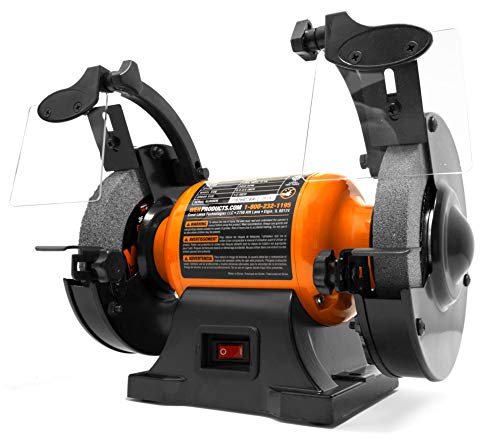
Best for: a beginner on the tightest outlay who wants a real 6-inch grinder rather than a hobby toy. Skip it if: you want the work light or you plan to run the grinder in a dim garage.
The BG4260 is the plain-jane sibling of the BG4276, and that is exactly why it earns the budget slot. Same 2.1-amp motor, same 3450 RPM claim, same 6-by-3/4-inch wheel size, same two included wheels (60-grit and 36-grit), same two-year warranty. What you lose is the flexible work light, and the body shrinks to 8 x 12 x 7.5 in at 14 lb. That is the smallest footprint in the whole roundup.
Two features WEN lists here that matter for a new user: pivoting tool rests and adjustable eye guards. Both are the parts a beginner adjusts most often, and both are called out explicitly in the listing. Against the pricier picks, you give up cast iron in the base and any variable speed. Against the BG4276 you give up the light. Everything else is the same on paper, which is why this is the pick when the outlay has to be minimal.
Pros:
- Cheapest of the six
- Lightest at 14 lb
- Pivoting tool rests
- Two-year stated warranty
- Both 60-grit and 36-grit wheels included
Cons:
- No work light
- Single speed only
- 1/2-inch arbors limit wheel options
- Lightest body may need bolting down
4. VEVOR MD150 — Runner-up
A 6-inch, 18.7 lb single-speed grinder with an LED work light and a cast-iron body claim, sitting mid-range in price.

Best for: a hobbyist who wants a heavier body than the WEN units without stepping up to the premium tier. Skip it if: you need a published warranty on the listing.
VEVOR pitches the MD150 as a 250W, 2.1A induction motor spinning at 3450 RPM, with a 36-grit wheel for fast material removal, a 60-grit wheel for finer work, an adjustable transparent eye shield, a built-in LED work light, and a cast iron body with a steel plate base. On paper, that is the WEN BG4276 spec sheet with more weight (18.7 lb versus 16 lb) and a slightly smaller 10.2 x 15 x 7.9 in footprint.
Two things push it into the runner-up slot rather than the top spot. First, the listing does not state a warranty length, whereas both WEN picks and the Bucktool do. Second, the model name shows up as MD150 with a specification tag that reads "6 in High-Speed w/ Light", which is a bit awkward to shop against when you are trying to match replacement parts later. Those are small quibbles. The MD150 is the pick if you want a heavier machine at a moderate price and you do not mind an unstated warranty.
Pros:
- Cast iron body with steel base claim
- Built-in LED work light
- 18.7 lb adds stability over the WEN units
- Both 36-grit and 60-grit wheels included
- 3450 RPM matches the WEN picks
Cons:
- No stated warranty on the listing
- Single speed only
- Model name is awkward for parts matching
5. Greteefor NS-SLJ-01-3 — Best for beginners
The only variable-speed grinder in the set, from 1725 to 3450 RPM, and by far the heaviest at 38.1 lb.

Best for: a first-time buyer willing to spend more upfront to avoid buying a second grinder later. Skip it if: your bench cannot hold a 38.1 lb machine or you want the cheapest way in.
This is the pick that earns the beginner label for a specific reason: it is the only unit here that lets you dial the wheel down. Greteefor states a 2.5A brushless induction motor with a 1725 to 3450 RPM range, tool-free adjustable guides, a stable work rest, a water tray for cooling metal, dual safety switches, an LED work light, and a heavy cast-iron base with anti-vibration rubber feet. The 38.1 lb weight is the second-heaviest published figure across bench grinders as a class and comfortably the heaviest here.
Why does variable speed matter for a beginner? Because the fastest way to ruin a chisel edge is to spin the wheel at 3450 RPM on hardened steel and cook the temper out. Slowing the wheel down for sharpening and speeding it up for stock removal is what an experienced user does. The Greteefor gives you both from one dial. The downsides are the price position and the bench footprint, and no warranty length is stated in the listing.
Pros:
- Variable speed from 1725 to 3450 RPM
- Brushless induction motor claim
- Cast-iron base at 38.1 lb
- Water tray for cooling included
- LED work light and dual safety switches
Cons:
- Second-highest price position here
- 38.1 lb needs a solid bench
- No stated warranty on the listing
6. Bucktool TLG-150S — Best for heavy use
A dedicated low-speed 6-inch grinder at 1750 RPM, with a published two-year warranty and dual aluminum-oxide wheels.

Best for: a beginner who already knows they want to sharpen tool steel and refuses to compromise on wheel speed. Skip it if: you also want variable speed or a work light.
The Bucktool is the specialist of the set. It runs one speed, and that speed is low. The listing quotes a 1/3 HP motor at 1750 RPM, a 60-grit brown aluminum oxide wheel paired with an 80-grit white aluminum oxide wheel, a tool-free adjustable work rest, a rubber-footed cast aluminum base, a transparent eye shield, a spark arrestor, and a 2-year limited warranty. At 22.4 lb it sits between the WEN and VEVOR bodies and the much heavier Greteefor.
The wheel pairing is the tell. An 80-grit white wheel is what you use to finish an edge without overheating it, and shipping one in the box means Bucktool expects this grinder to spend its life on sharpening rather than rough grinding. If you already know you bought the tools you are trying to protect, that matters. Against the Greteefor, it loses on flexibility because you cannot speed the wheel up. Against everything else here, it wins on wheel selection out of the box.
Pros:
- Dedicated 1750 RPM low speed
- 60-grit and 80-grit wheel pairing
- 2-year limited warranty stated
- Cast aluminum base with rubber feet
- Spark arrestor included
Cons:
- Single low speed only
- No work light listed
- Narrower use case than the other picks
Why RPM matters more than horsepower on paper
Most beginner comparisons lead with horsepower or amperage. That is the wrong specification to look at first.
RPM is what decides whether your grinder ruins the tool you are trying to sharpen. A 6-inch wheel at 3450 RPM moves the wheel surface roughly twice as fast as the same wheel at 1750 RPM. Heat builds up on the workpiece in proportion to that surface speed, and if you are grinding hardened steel, that heat is what draws the temper back out and softens the edge. That is why the Bucktool sits at 1750 RPM as a deliberate choice, and why the Greteefor's 1725 to 3450 RPM range is the flexibility a beginner grows into.
The horsepower and amperage figures across this set actually cluster tighter than the marketing suggests. WEN says 2.1 amps for both units. VEVOR says 250W and 2.1A. Greteefor says 2.5A. Bucktool and DEWALT quote 1/3 HP and 3/4 HP respectively. For beginner work on hand tools and bits, none of those motors is the bottleneck. The wheel speed is.
What the listings do not tell you
- Arbor size matters when you replace wheels. Both WEN listings state 1/2-inch arbors. The others do not publish an arbor spec, so measure before you buy replacement wheels.
- Wheel width shows up on the WEN units as 3/4 inch. That is standard for 6-inch grinders in this class, but do not assume the VEVOR, Greteefor and Bucktool wheels are the same width.
- Cast iron versus cast aluminum shows up in three listings. The DEWALT says cast iron base and housing, the Greteefor says cast iron base, the Bucktool says cast aluminum base. The two WEN units and the VEVOR do not name the base material clearly enough to compare.
- Warranty is only published on three listings: both WEN picks and the Bucktool, all at two years. DEWALT, VEVOR and Greteefor do not state a warranty length in the specs you see before purchase.
- No listing here publishes decibel levels, so pump-noise comparisons are not possible.
What more money actually buys in this set
The two WEN units sit at the entry end. The VEVOR and Bucktool sit in the middle. The Greteefor and DEWALT sit at the top. What changes as you climb?
At the entry end, you get a competent single-speed 6-inch grinder with 3450 RPM, two wheels and a two-year warranty. That is the WEN BG4260.
Step up to the mid range and you add weight. The VEVOR moves to 18.7 lb with a stated cast iron body and a work light. The Bucktool trades the work light for a dedicated 1750 RPM low speed and an 80-grit finishing wheel.
Step up to the premium tier and you buy one of two things. Either variable speed and a 38.1 lb cast-iron body with a water tray, which is the Greteefor. Or an 8-inch wheel on a 3/4 HP induction motor with rear-exhaust wheel guards, which is the DEWALT. You do not get both in one machine anywhere in this set.
Setup and safety a first-timer should not skip
- Bolt the grinder down. Every pick here has mounting holes in the base. A 14 lb grinder like the BG4260 will walk across a bench under load if it is not fixed.
- Set the tool rest gap to less than 1/8 inch from the wheel. Every listing here includes adjustable tool rests. Use them.
- Adjust the eye guard before you switch on, not after. The WEN, VEVOR, Greteefor and Bucktool listings all describe adjustable transparent shields.
- Wear safety glasses on top of the shield. The shields catch sparks. They are not a substitute for glasses.
- Dress the wheel before first use. The Greteefor ships with a wheel dresser in the listing. If your pick does not, buy one separately.
- Let the wheel come up to speed before touching work to it. On a 3450 RPM machine, that is under two seconds. On the Bucktool at 1750 RPM, it is roughly the same.
The verdict
The WEN BG4276 is the best budget bench grinder for beginners in this set. It combines a 2.1-amp motor at 3450 RPM, a 6-inch wheel with a 3/4-inch face, a 60-grit and 36-grit wheel pair, a flexible work light, and a two-year stated warranty in a 16 lb body that fits a shared bench. Nothing else in the set gives you that full combination at the entry-price end.
Two conditions flip the recommendation. If you already know you want to sharpen woodworking tools on a flatter 8-inch grind, the DEWALT DW758 is the right buy: 8-inch wheel, 3/4 HP induction motor at 3600 RPM, cast iron base and housing. If you want to slow the wheel down for hardened steel and speed it up again for stock removal, the Greteefor NS-SLJ-01-3 is the pick, running from 1725 to 3450 RPM on a 38.1 lb cast-iron body with a water tray. The BG4260 stays in the mix as the cheapest way in for anyone who does not need the work light. Everything else in this roundup sits between those poles.
FAQ
Is a 6-inch bench grinder enough for a beginner?
A 6-inch bench grinder is enough for the work most beginners actually do: sharpening drill bits, screwdrivers, mower blades and small chisels, plus deburring metal stock. Five of the six picks here run 6-inch wheels for exactly that reason. Replacement wheels are cheaper and easier to find in this size. Step up to 8 inches only if you know you want a flatter grind face.
Is the WEN BG4276 worth it over the cheaper BG4260?
The WEN BG4276 is worth it if a work light matters to you. Both units share the 2.1-amp motor, the 3450 RPM claim, the 6-by-3/4-inch wheel spec, the 60-grit and 36-grit wheels, and the two-year warranty. The BG4276 adds the flexible work light and gains 2 lb of body weight (16 lb versus 14 lb). If you already have good bench lighting, the BG4260 saves you the outlay.
How does the Bucktool compare to the Greteefor for sharpening?
The Bucktool runs one speed at 1750 RPM and ships with 60-grit and 80-grit aluminum oxide wheels aimed at sharpening. The Greteefor gives you a 1725 to 3450 RPM range plus a water tray, so it slows down for sharpening and speeds up for stock removal. Choose the Bucktool if you only sharpen. Choose the Greteefor if you also want to grind and shape metal on the same machine.
What wheel grits should a beginner have?
Beginners want two grits on the machine: one coarse for stock removal and one fine for finishing. The WEN, VEVOR and Bucktool listings all ship two wheels in the box. WEN and VEVOR pair a 36-grit wheel with a 60-grit wheel. Bucktool pairs 60-grit with an 80-grit white aluminum oxide wheel aimed at finishing hardened steel without overheating the edge.
What is the biggest mistake first-time buyers make?
The biggest mistake first-time buyers make is chasing horsepower and ignoring wheel speed. A high-RPM grinder overheats tool steel and softens the edge you are trying to sharpen. That is why the Bucktool deliberately runs low at 1750 RPM and the Greteefor lets you dial from 1725 to 3450 RPM. Pick the speed first, then the wheel size, then worry about the motor rating on the box.
If you are starting from nothing, the WEN BG4276 is the grinder to plug in first. It gives you a 6-inch wheel at 3450 RPM, both a coarse and a fine wheel in the box, a work light attached to the machine, and a stated two-year warranty in a 16 lb body you can move off the bench when you need the space back. Buy a wheel dresser, bolt the grinder down, and set the tool rest gap under 1/8 inch before you power it up. If your first project is sharpening chisels or plane irons rather than reviving bits and blades, save the money and put it toward the Greteefor's variable speed instead. Either way, wheel speed is the specification that decides how the grinder treats your tools.