Best Slow Speed Bench Grinders for Metal Work
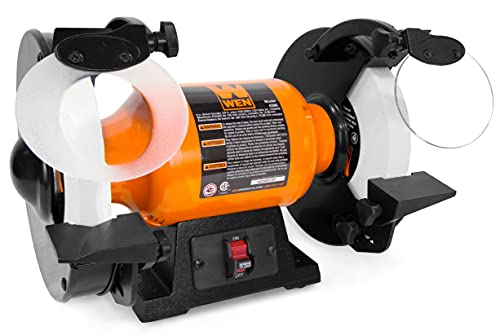
A slow speed bench grinder saves the temper on your steel. Six picks compared on wheel size, RPM range and base weight, with the WEN BG4286 leading the set.

By Jo LoweryUpdated 16 min read
On this page
- Best slow speed bench grinder for metal work at a glance
- How I screened the field down to six
- What actually decides a slow speed bench grinder for metal work?
- 1. WEN BG4286 — Best overall
- 2. Bucktool TLG-150S — Best budget pick
- 3. WEN BG625V — Best for families
- 4. Bucktool TDS-200DS — Most versatile
- 5. Greteefor NS-SLJ-01-3 — Best upgrade
- 6. Woodskil TDS-G200VLGA — Best premium
- Fixed 1750 RPM or variable speed: which suits metal?
- Wheel size, base weight and vibration
- What the listings do not tell you about metal work
- If your workshop is tight on space
- The verdict
- FAQ
The best slow speed bench grinder for metal work is the WEN BG4286, an 8-inch, 1750 RPM machine with a soft-start 3-amp motor and 34.1 lb of mass to soak up vibration. If your bench is short on space or your budget is tight, the 22.4 lb Bucktool TLG-150S runs the same 1750 RPM through a 1/3HP motor on a 6-inch pair of wheels. Six picks here, three sitting at true slow speed and three trading it for a variable dial.
Best slow speed bench grinder for metal work at a glance
| Pick | Wheel & RPM | Weight | Price |
|---|---|---|---|
Best overall WEN BG4286 |
8 in, 1750 RPM | 34.1 lb | Check Price |
Best budget pick Bucktool TLG-150S |
6 in, 1750 RPM claim | 22.4 lb | Check Price |
Best for families WEN BG625V |
6 in, 2000–3400 RPM | not listed | Check Price |
Most versatile Bucktool TDS-200DS |
8 in, dual speed | 45.1 lb | Check Price |
Best upgrade Greteefor NS-SLJ-01-3 |
6 in, 1725–3450 RPM | 38.1 lb | Check Price |
Best premium Woodskil TDS-G200VLGA |
8 in, 2000–3450 RPM | not listed | Check Price |



How I screened the field down to six
I started with the wider Bench Grinders category on Amazon and pulled six machines that either advertise a slow speed of around 1750 RPM outright or offer a variable dial that reaches down into that band. Every pick sits in the same category path and each is listed by a single seller, so availability is comparable across the set.
From there I compared the published specifications side by side: wheel diameter, motor amps or horsepower, quoted RPM, base weight, dimensions and stated warranty. Anything sold without a stated wheel size or a stated RPM range was cut early. A grinder that will not tell you how fast it spins is not a slow speed bench grinder for metal work in any meaningful sense.
Two more filters applied. First, the grinder had to publish enough dimension data to plan a bench layout around it. Second, the manufacturer had to state what wheels ship in the box, since a slow speed bench grinder for metal work with the wrong grit pair is a project on day one. Six machines cleared both bars. Three run at a fixed 1750 RPM in their marketing, and three carry a variable dial that starts around 1725 to 2000 RPM and climbs from there.
What actually decides a slow speed bench grinder for metal work?
Most buyers compare motor amps first. That is the wrong lead. A 2.5-amp brushless motor and a 3-amp brushed motor can behave almost identically on a small chisel edge, and neither will decide whether you blue the steel. Speed decides that.
The best slow speed bench grinder for metal work is one that keeps the wheel surface under the temperature where hardened tool steel loses its temper. That means an RPM figure at or near 1750 for an 8-inch wheel, or a similar surface speed on a 6-inch wheel, and it means enough mass in the base to keep the wheel true.
- RPM first, because heat scales with wheel surface speed.
- Wheel diameter second, because a larger wheel does more work per pass at the same RPM.
- Base weight third, because a light grinder wanders under load and chatters against a hollow-ground edge.
- Wheel grit pair fourth, because a coarse and a fine wheel out of the box saves a separate purchase.
Feature bullets about "professional quality" or "smooth performance" are the manufacturer's words. They are not evidence. What is evidence: WEN's BG4286 lists 1750 RPM and 34.1 lb. Bucktool's TDS-200DS lists 45.1 lb and a dual-speed motor. Those are numbers you can plan around.
1. WEN BG4286 — Best overall
The 8-inch WEN BG4286 pairs a soft-start 1750 RPM motor with 34.1 lb of base mass and both a 60-grit and a 120-grit wheel out of the box, which is the shortest path to grinding hardened steel without cooking it.
Best for: restoring old chisels, plane irons and knife edges without bluing the steel Skip it if: you want to dial the speed down further for very fine sharpening
This is the only 8-inch machine in the set that runs at a true 1750 RPM without a variable dial, and it is the pick that most directly matches the shape of a slow speed bench grinder for metal work. WEN quotes a 3-amp motor turning 8-by-1-inch wheels at up to 1750 RPM, with what the listing calls a soft start. The 34.1 lb weight is heavier than the 22.4 lb Bucktool budget pick and lighter than the 45.1 lb Bucktool combo, and the footprint is 8 x 14.5 x 7.75 in, which is the second-smallest in the set. The listing includes pivoting tool rests, adjustable eye guards and pre-drilled mounting holes. The trade-off against the Bucktool TDS-200DS is 11 lb less base mass and no buffing wheel; against the Greteefor upgrade, no variable dial and no water tray. What it buys instead is simplicity: one speed, an 8-inch wheel, and two grits that cover most metal work out of the box.
Pros:
- Fixed 1750 RPM, no dial to nudge off target
- 8-inch wheels for more work per pass
- 60-grit and 120-grit wheels included
- Soft-start motor claim reduces startup jolt
- Pre-drilled mounting holes in the base
Cons:
- No published warranty in the listing
- No work light on the grinder
- No variable speed if you want to slow further
2. Bucktool TLG-150S — Best budget pick
The Bucktool TLG-150S is the cheapest of the six and the only one under 23 lb, a 6-inch 1/3HP grinder that Bucktool positions at 1750 RPM with a stated 2-year limited warranty.

Best for: a first grinder for a hobby bench, or a compact 6-inch station Skip it if: you plan to grind larger stock that wants an 8-inch wheel
At 22.4 lb this is the lightest machine in the set, which cuts both ways: easier to move, but it will need bolting down for anything more than light edge work. The footprint is 12.6 x 13.8 x 7.87 in, and Bucktool claims a 1/3HP motor delivering 1750 RPM. The listing describes a 60-grit brown aluminium oxide wheel paired with an 80-grit white aluminium oxide wheel, which is a better metal-work pair than a 36/80 pair aimed at rough stock. A tool-free adjustable work rest and a cast aluminium base with rubber feet come as standard, and Bucktool states a 2-year limited warranty, which is one of only two in the set. The trade-off against the WEN BG4286 is smaller wheels and a lighter base; against the Bucktool combo, no buffing wheel and less mass. If your only metal work is knives, chisels and small tool steel, the smaller machine is enough.
Pros:
- Cheapest of the six
- 2-year limited warranty stated
- 60-grit and 80-grit wheels included
- Cast aluminium base with rubber feet
- Tool-free adjustable work rest
Cons:
- Lightest base in the set at 22.4 lb
- 6-inch wheels limit larger work
- Fixed speed, no dial for lower RPM
3. WEN BG625V — Best for families
The WEN BG625V trades a true slow speed floor for a 2000 to 3400 RPM variable dial, a flexible work light, and a 36/80 grit pair that suits shared workshops moving between rough stock and finer edges.

Best for: a shared home workshop where the grinder handles knives one day and rough stock the next Skip it if: you want a true slow speed floor, since it starts at 2000 RPM
Read the RPM range carefully. This is the only machine in the set whose lower speed is 2000 RPM rather than about 1750, so it does not sit at the same slow-speed floor as the WEN BG4286 or the Bucktool TLG-150S. What it offers instead is range: 2.5 amps, 2000 to 3400 RPM, a flexible work light, a two-year warranty and both a 36-grit and an 80-grit wheel. The 36-grit is a heavy-stock wheel, useful for cleaning up a mower blade or a shovel, less useful on a chisel where a 120-grit finish wheel is more common. The footprint is 17.3 x 15.4 x 9.65 in, wider than either of the pure slow-speed picks. The trade-off against the BG4286 is that you can never run this one at 1750 RPM. What you gain is a wider working envelope for a mixed workshop and a light that keeps the wheel edge visible.
Pros:
- Two-year warranty stated
- Flexible work light included
- Variable dial from 2000 to 3400 RPM
- 36-grit and 80-grit wheels shipped
- Wider working envelope for mixed jobs
Cons:
- Lowest speed of 2000 RPM, not true slow
- 36-grit is coarse for delicate metal work
- Base weight not published in the listing
4. Bucktool TDS-200DS — Most versatile
At 45.1 lb on a cast iron base, this 8-inch dual-speed Bucktool is the heaviest pick here, and the only one to ship with a buffing wheel alongside its 80-grit and 120-grit metal wheels.
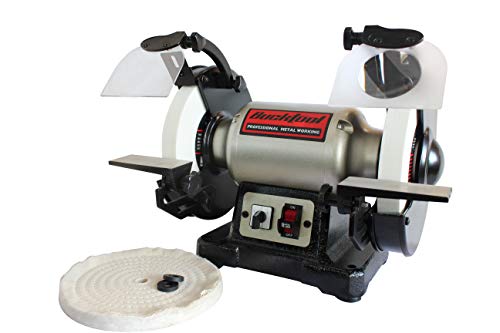
Best for: anyone who wants to grind and buff on the same machine without swapping wheels Skip it if: you have to lift the grinder on and off the bench often
The mass matters. 45.1 lb on a cast iron base is roughly double the Bucktool TLG-150S and 11 lb over the WEN BG4286, which is what you want if you plan to grind harder than a chisel edge. Bucktool quotes a 1/2HP dual-speed induction motor with steady torque at both speeds, and the listing pairs an 80-grit and a 120-grit white aluminium oxide wheel with a buffing wheel for polishing. Two independently adjustable cast aluminium tool rests are supplied to compensate for wheel wear. The footprint is 16.5 x 16.9 x 10.6 in, and a 2-year limited warranty is stated. The trade-off against the WEN BG4286 is a heavier and larger machine, sitting in the premium band of this set. Against the Woodskil premium pick, this one lists its full weight, its dimensions and its warranty, which the Woodskil listing does not.
Pros:
- Heaviest in the set at 45.1 lb
- Cast iron base with mounting holes
- Buffing wheel included with two metal wheels
- Dual-speed induction motor
- 2-year limited warranty stated
Cons:
- Highest listed weight to lift and store
- Larger footprint than the fixed-speed picks
- Premium band of this set
5. Greteefor NS-SLJ-01-3 — Best upgrade
The Greteefor pairs a 1725 to 3450 RPM variable range with a brushless motor and a water tray for cooling, which is the closest thing in this set to a purpose-built sharpening station.

Best for: sharpeners who cool their steel between passes and want a quieter brushless motor Skip it if: you specifically want a fixed slow speed, since this one goes up to 3450 RPM
Two things set this pick apart in the set. The listed motor is a 2.5A brushless induction unit, which Greteefor claims is quieter and longer-lived than a brushed equivalent. The stated speed range starts at 1725 RPM, the lowest floor here, and reaches 3450 RPM at the top. The listing also describes a water tray for cooling metal between passes and a wheel dresser included in the box, neither of which the other picks mention. At 38.1 lb the base is heavier than either WEN, on a 10 x 14 x 11 in footprint, and the manufacturer describes a cast-iron base with anti-vibration rubber feet. The trade-off against the WEN BG4286 is that you must set the speed yourself; against the Bucktool TDS-200DS, no buffing wheel and no stated warranty. What you gain is a machine set up for careful sharpening rather than heavy stock removal.
Pros:
- Widest variable range from 1725 to 3450 RPM
- Brushless motor claim for quieter operation
- Water tray for cooling included
- Wheel dresser bundled in the box
- Heavier base than either 6-inch alternative
Cons:
- No published warranty in the listing
- 6-inch wheels, not 8-inch
- Speed must be dialled in every session
6. Woodskil TDS-G200VLGA — Best premium
The Woodskil is the only pick with a digital RPM readout, pairing an 8-inch wheel with a 5-amp 3/4HP motor and a 2000 to 3450 RPM range under the digital display.
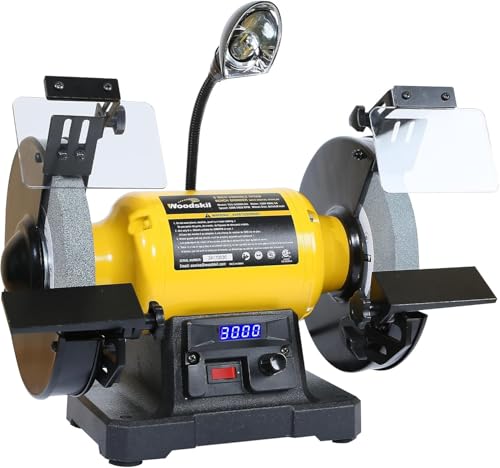
Best for: knife makers who want a digital RPM readout and an 8-inch wheel Skip it if: you need a published warranty and a stated base weight before you buy
This is the most expensive pick here and it is the only one whose speed is shown on a display rather than set from a dial and guessed. Woodskil lists a 5-amp 3/4HP motor and a 2000 to 3450 RPM range, with a 2W built-in work light and a footprint of 13.4 x 17.3 x 10.2 in. The listing mentions non-slip rubber pads and a pre-drilled rigid steel base for wobble-free grinding. Speed floor matters again: at 2000 RPM this does not reach the 1725 to 1750 RPM band that the WEN BG4286, the Bucktool TLG-150S and the Greteefor all touch, so it is a variable grinder with an 8-inch wheel rather than a true slow speed machine. The trade-off against the Bucktool TDS-200DS is that Woodskil does not publish a weight or a warranty in this listing, both of which Bucktool does. What you gain is the digital readout and a stronger stated motor.
Pros:
- Digital RPM display, unique in this set
- 5-amp 3/4HP motor stated
- 8-inch wheel size
- Built-in 2W work light
- Pre-drilled rigid steel base
Cons:
- Base weight not published in the listing
- No warranty stated in the listing
- Minimum speed of 2000 RPM, not 1750
Fixed 1750 RPM or variable speed: which suits metal?
The split down the middle of this set is speed. Three machines pin the wheel at or near 1750 RPM. Three offer a variable dial that starts higher, at 2000 RPM, or lower, at 1725 RPM, and climbs to 3400 or 3450 RPM.
For metal work specifically, that is the decision. A fixed 1750 RPM machine cannot go wrong on hardened tool steel: the wheel surface stays cool, the risk of drawing the temper drops, and there is nothing to knock off target between jobs. A variable machine gives you access to higher speeds when you want to hog off stock, but only two of the variable picks here, the Greteefor at 1725 RPM and none of the WEN or Woodskil variable models, actually let you set a speed as low as the fixed pair.
- Choose fixed at 1750 RPM if you sharpen hardened edges more than you shape rough stock.
- Choose variable starting at 1725 RPM if you want the option of one machine for both.
- Skip variable models that bottom out at 2000 RPM if slow speed is your only reason for buying.
That is why the best slow speed bench grinder for metal work in this set is a fixed-speed machine.
Wheel size, base weight and vibration
Three of the picks run 8-inch wheels and three run 6-inch wheels. Larger wheels present more cutting surface, hold a truer profile between dressings, and are what most metalworkers reach for once they have space. Smaller wheels win on footprint and price.
Base weight follows a similar pattern. The 45.1 lb Bucktool TDS-200DS is roughly double the 22.4 lb Bucktool TLG-150S. The 38.1 lb Greteefor sits between them, and the 34.1 lb WEN BG4286 is closer to the middle. Both WEN variable models and the Woodskil premium pick do not publish a base weight, which is a real gap when you are planning a bench.
- Under 25 lb: bolt it down, or expect it to walk on heavy jobs.
- 25 to 40 lb: stable on a solid bench with rubber feet.
- Over 40 lb: heavy enough to soak up vibration on rough stock removal.
Every one of these grinders lists a pre-drilled base or mounting holes. Use them. The best slow speed bench grinder for metal work does not fight you at the wheel, and bolting the base down is the single cheapest upgrade you can make to any of these six.
What the listings do not tell you about metal work
Amazon listings for bench grinders repeat some claims and stay quiet on others. A few gaps are worth calling out before you buy.
Wheel quality varies. Manufacturers ship a coarse and a fine wheel, but the grade of aluminium oxide and the hardness of the bond are not always stated. Many metalworkers dress or replace the shipped wheels after a season. A grinder is a mount for wheels as much as it is a motor.
Tool rests are minimum-spec. Every pick advertises an adjustable rest, and most are usable. Serious sharpeners often add an aftermarket rest with a groove for a jig. Nothing in these listings changes that pattern.
Warranty coverage is uneven. Both Bucktool machines and the WEN BG625V state a two-year warranty. The WEN BG4286, the Greteefor and the Woodskil do not publish one in their listings.
Noise is not quantified. The Greteefor listing claims quieter brushless operation, but no pick states a decibel figure. If a shared house is a concern, mass and mounting help more than the motor spec.
The word "metalworkers" appears in the Bucktool TLG-150S listing and the modifier "metal work" fits three of the six picks well. It is a shopping consideration, not a certification, and you will want to judge each grinder on its RPM, wheel size and base weight.
If your workshop is tight on space
Not every bench has room for a 17-inch-wide grinder. Two picks in this set have footprints under 13 inches on the long axis:
- The WEN BG4286 at 8 x 14.5 x 7.75 in, which is the smallest 8-inch machine here.
- The Bucktool TLG-150S at 12.6 x 13.8 x 7.87 in, the smallest 6-inch machine.
The Bucktool TDS-200DS at 16.5 x 16.9 x 10.6 in and the WEN BG625V at 17.3 x 15.4 x 9.65 in are the widest of the six. If your bench is short, the choice is really between the WEN BG4286 and the Bucktool TLG-150S, and the deciding factor is wheel size rather than layout: 8-inch for more work per pass, 6-inch for the smallest bench station in the set.
Store the grinder near a bolted plate rather than clamped on and off, and the lighter Bucktool becomes far more capable than its 22.4 lb suggests.
The verdict
If you want a slow speed bench grinder for metal work in one line, the WEN BG4286 is the pick. Fixed 1750 RPM, an 8-inch wheel, 34.1 lb of base mass, a 60-grit and a 120-grit wheel out of the box, and the smallest footprint of any 8-inch machine here. Nothing has to be dialled in.
Two tracks branch off it. If your bench is small, your budget is tight, or you only sharpen small tool steel and knives, the Bucktool TLG-150S runs the same 1750 RPM through a 1/3HP motor on 6-inch wheels, weighs 22.4 lb, and adds a stated 2-year limited warranty. If your metal work runs closer to buffing, polishing and heavier stock removal, the Bucktool TDS-200DS puts 45.1 lb on the bench, adds a buffing wheel to the 80/120 grit pair, and pairs its 1/2HP dual-speed motor with a cast iron base.
The cutoff is wheel size and speed floor. Below 8 inches and 34 lb, the Bucktool TLG-150S. At 8 inches and 34 lb, the WEN BG4286. Above 40 lb with a buffing wheel, the Bucktool TDS-200DS.
FAQ
Is a slow speed bench grinder for metal work worth it over a standard grinder?
A slow speed bench grinder for metal work is worth it if you sharpen hardened tool steel. A 1750 RPM wheel keeps the steel cooler than a 3450 RPM wheel at the same pressure, which reduces the risk of drawing the temper on a chisel, plane iron or knife edge. For rough stock removal on mild steel, a faster wheel is often quicker, and a variable model can serve both jobs.
What RPM counts as slow speed on a bench grinder?
The RPM that counts as slow speed sits at or near 1750 RPM for an 8-inch wheel, which is roughly half the 3450 RPM common on standard grinders. In this set, the WEN BG4286 and the Bucktool TLG-150S run a fixed 1750 RPM, and the Greteefor NS-SLJ-01-3 dials down to 1725 RPM. The WEN BG625V and the Woodskil TDS-G200VLGA bottom out at 2000 RPM, which is faster than a true slow speed floor.
WEN BG4286 or Bucktool TLG-150S for a first metal grinder?
WEN BG4286 or Bucktool TLG-150S comes down to bench space and wheel size. The WEN BG4286 has 8-inch wheels, 34.1 lb of mass and a soft-start 3-amp motor, and it is the better pick for anyone who will grind larger stock. The Bucktool TLG-150S has 6-inch wheels, weighs 22.4 lb, publishes a 2-year warranty and costs less. Choose it for a compact bench or a first hobby grinder.
Can a variable speed grinder replace a slow speed grinder?
A variable speed grinder can replace a slow speed grinder only if its lowest setting is genuinely slow. The Greteefor at 1725 RPM covers the same floor as a fixed 1750 RPM machine. The WEN BG625V at 2000 RPM and the Woodskil at 2000 RPM do not, so they run faster than a true slow speed grinder even at their lowest dial position. Check the minimum RPM on any variable model before you buy.
What is the biggest mistake buyers make with a bench grinder?
The biggest mistake buyers make is choosing on motor amps instead of RPM and mass. A 2.5-amp motor turning at 1725 RPM on a 38 lb base does more careful metal work than a 5-amp motor turning at 3450 RPM on a lighter frame. Wheel surface speed decides heat build-up, and base weight decides chatter. Pick the RPM floor first, then the wheel size, then the mass, and only then the motor rating.
A slow speed bench grinder for metal work is a long-term buy, so let the numbers do the choosing rather than the marketing. Match the wheel size to your bench, match the RPM to the steel you sharpen most, and bolt the base down before the first cut. For most workshops the WEN BG4286 is the shortest route to that setup: an 8-inch wheel, a fixed 1750 RPM, a soft-start motor and a compact footprint on a 34.1 lb base. Start there, dress the wheels when they load up, and add a purpose-built tool rest when your sharpening starts asking for one.